PAYPER
https://www.payper.com/About
Next-Generation Bagging Lines for Pet Food
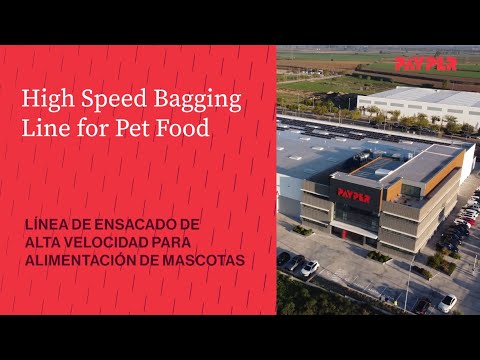
PAYPER, a Spanish company founded in 1973, specializes in designing and manufacturing machinery for dosing, weighing, bagging, palletizing, and overwrapping solutions. For more than 50 years, we have developed unique features for pet food bagging, such as air extraction from the bag to extend product shelf life or the patented technology for levelling the top of the bag to ensure a flawless closure.
PET FOOD industry customers in Latin America, have trusted us with more than 500 projects installed using PAYPER technology. From our subsidiaries in Mexico and Brazil, we offer a comprehensive service covering all the steps from the sales phase to after-sales and spare parts supply, guaranteeing close attention throughout the process.
With 8 subsidiaries and representation worldwide, our local sales and service organizations are at your disposal to answer any questions and offer you the solution that best suits your specific needs.
Contact us today to learn more about how PAYPER can help you improve your pet food bagging and palletizing operations.
Products


Company News
 Packaging
4+ MIN
24/02/2026
Trends in Pet Food Bagging: Innovation, Precision, and Efficiency for a Growing Industry
This growth not only impacts food formulation, but also the industrial processes that ensure its preservation, safety, and presentation. In this context, pet food bagging has come to occupy a strategic place within the production chain.
The final packaging serves multiple purposes: protecting the food from moisture and contamination, facilitating storage and transport, and providing attractive presentation at the point of sale. At the same time, it must be practical and resistant for the end consumer. For this reason, pet food manufacturers are seeking technological solutions that combine efficiency, versatility, and quality control throughout the bagging process.
Formats and materials: versatility as a competitive advantage
The bag format is one of the most decisive factors in the industry. Dry pet food is usually packaged in polypropylene or laminated polyethylene bags, materials that offer high mechanical resistance and protection against moisture, oxygen, and pests. These materials preserve the crunchy texture of the product and extend its shelf life.
Traditionally, the most common formats are between 5 and 20 kg, ideal for owners with several pets or for distributors. However, the current trend shows sustained growth in demand for smaller bags, less than 5 kg, designed for consumers seeking convenience or higher turnover products.
This change requires manufacturers to have flexible bagging equipment that can quickly adapt to different bag sizes and types without compromising production speed.
PAYPER automatic pet food bagging machines are designed precisely to offer this versatility: they allow for quick and automatic format changes, with systems that adjust measurements without the need for manual intervention. In addition, the horizontal empty bag storage system provides operational autonomy, as it can hold up to six stacks of bags ready for the next cycle.
Before sealing, an automatic alignment system ensures that the bag mouth is perfectly level, guaranteeing a precise and professional finish. If the process requires it, double welding adds an additional layer of protection against moisture and contamination.
Dosing and weighing: accuracy in every bag
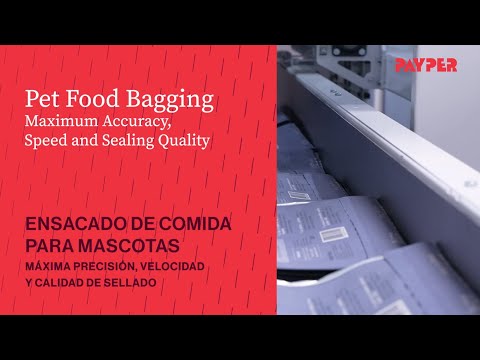
In pet food, product homogeneity and weight accuracy are essential to meet quality standards. PAYPER has developed the MSX weighing controller, one of the most accurate technologies on the market. Accredited by official metrology institutions, this system was specifically designed for high-speed bagging processes and ensures accurate dosing even on lines with high production throughput.
The MSX combines speed and reliability, maintaining product consistency without generating overweight or losses. Depending on the characteristics of the food—density, particle size, or flowability—the most suitable dosing system is selected, ensuring a stable and controlled flow at all times.
Product protection: guaranteed freshness and preservation
Maintaining the quality of dry food throughout its life cycle is a key challenge. PAYPER pet food bagging lines incorporate residual air extraction and deaeration technologies, which remove excess air from inside the bag and achieve a more compact and stable package. In some cases, the air is replaced by inert gas (such as nitrogen), a technique that prevents oxidation and deterioration of the ingredients, prolonging the freshness of the product.
In addition, the double top seal reinforces the airtight closure and provides extra protection against moisture, dust, and temperature variations. In this way, manufacturers can ensure that each batch retains its nutritional and organoleptic properties until it reaches the consumer.
Quality control: safety at every stage of the process
The pet food industry shares very similar standards to those of the human food sector. For this reason, PAYPER lines incorporate automatic inspection and control systems that verify compliance with all safety and quality parameters.
These include:
Checkweighers, which verify that each bag meets the nominal weight.
Metal detectors, which guarantee the absence of metal contaminants.
Automatic rejection systems, which remove any bag that does not meet the standards from the line.
This total control ensures that only compliant products reach the market, reinforcing the end customer's confidence and the manufacturer's reputation.
Palletizing and wrapping: presentation and logistics in balance
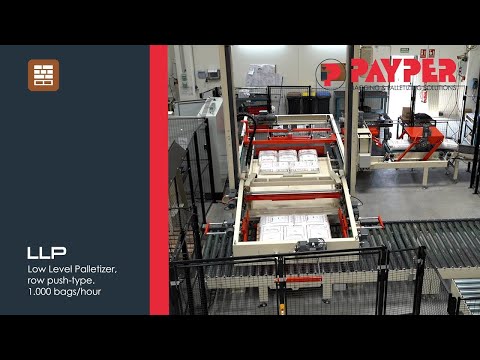
Once the bag has been sealed, the next step is to ensure flawless handling and presentation. PAYPER bag palletizing systems, available in robotic palletizing and conventional palletizing versions, are designed to handle each bag gently and precisely. The result is a perfectly square and stable pallet, ready for storage or transport.
High-speed palletizers incorporate telescopic belt feeders and specialized gripping heads, capable of maintaining the integrity of the bag even at intensive production rates.
Finally, Stretch Hooding and Stretch Wrapping protects pallets from moisture, dust, and UV rays, ensuring their stability during transport. This stage not only contributes to logistical safety, but also improves the final image of the product, an aspect that is increasingly valued by brands.
Commitment to innovation and customer focus
With over 50 years of experience and more than 5,000 projects completed in over 80 countries, PAYPER has established itself as a global leader in complete bagging lines. Its network of eight international subsidiaries and local technical service teams enable it to offer immediate and personalized assistance, adapting to the specific needs of each customer and region.
Conclusion: Pet Food bagging as an essential part of product value
Current trends in the pet food market point to greater automation, precision, and sustainability. Pet Food bagging is no longer considered a secondary stage in the process, but rather a key element in ensuring the quality and competitiveness of the final product.
PAYPER bagging solutions integrate all critical elements—dosing, weighing, bagging, palletizing, and strapping—into complete, flexible, and customized lines. Thanks to its focus on efficiency and technological innovation, PAYPER accompanies the pet food industry toward a more secure, sustainable, and profitable future.
Source: PAYPER
 Market Information
1+ MIN
24/12/2025
PAYPER Drives Its Growth with a New 8,800 m² Industrial Warehouse in Bell-lloc
PAYPER takes another step forward in its growth plan with the development of the second phase of its facilities at its headquarters in Bell-lloc, a strategic project that will involve an investment of €6 million and is scheduled to begin in January 2026.
The expansion includes the construction of a new 8,800 m² industrial warehouse, designed to strengthen the company's production and operational capacity in the design and manufacture of complete custom-made bagging and palletizing lines.
With the launch of this new phase, PAYPER will now have a factory covering more than 18,000 m², consolidating facilities capable of supporting the company's growth and offering its customers a rapid, personalized response tailored to their needs.
This project reinforces PAYPER's commitment to sustainable growth and the continuous improvement of its infrastructure, investing in facilities that support the company's evolution and its vision for the future.
Source: PAYPER
 Market Information
2+ MIN
12/04/2024
PAYPER receives ISO 9001 certification for quality management
We are pleased to announce that PAYPER has been certified to the internationally recognized ISO 9001:2015. The certification for PAYPER's quality management system was awarded on March 7, 2024, and issued through Bureau Veritas, a leading global certification entity.
PAYPER's certification covers a broad range of our operations, from engineering to sales, R+D, purchase, manufacturing, warehouse management, commissioning and services such as customer support and spare parts management. So, it covers all internal processes of our organization including the interactions with our suppliers and customers.
The rigorous criteria of the certification ensure ongoing analysis and improvement of product quality so that our solutions for bagging, palletizing and wrapping are even more aligned with customers' needs.
'Acquiring ISO 9001 accreditation validates our ongoing commitment to high standards of quality and excellence in all aspects of our business. Moreover, the certification process has been an opportunity to identify areas for improvement and ultimately strengthen our business.'
Josep Mª Godia, Managing Director at PAYPER.
At PAYPER, we are proud to reach this important milestone and remain dedicated to upholding our commitment to excellence for our valued customers.
What is ISO 9001?
ISO 9001 is a globally recognized certification standard that defines the requirements for establishing a Quality Management System (QMS). It was developed and published by the International Organization for Standardization (ISO).
This certification provides a framework for organizations to define, implement, maintain, and continually improve their quality management processes and procedures.
The ISO 9001:2015 standard is based on numerous quality management principles, such as a robust emphasis on customer satisfaction, a process-oriented approach, active involvement from top management and an ongoing commitment to improvement.
Compliance with ISO 9001 demonstrates an organization's ability to consistently provide products and services that meet regulatory requirements and focus on customer satisfaction. Many organizations worldwide seek ISO 9001 certification to demonstrate their commitment to quality and improve their overall performance.
Download PAYPER's ISO 9001:2015 Quality Certificate
Source: PAYPER.
 Market Information
4+ MIN
01/05/2023
Press Realease - PAYPER focuses on digitalization, accuracy and performance.
PAYPER stands for accuracy, control and performance Accuracy Weighing has been at the centre of interest in PAYPER's R&D&I department ever since the first weighing device was designed in 1973. In line with the ongoing commitment to weighing accuracy, PAYPER will present MSX: a new dynamic weight controller. It ensures maximum accuracy at high bagging speeds, being one of the most accurate weighing systems in the bagging industry. Accredited by official metrology institutions, it is specifically designed for the bagging of all types of solid products: granules, flakes and fine powders. Control Pulsar ensures full control of the production processes with a single click. This new cloud-based software solution enables bulk good producers to digitalize their bagging lines taking their production to the next level. At PACK EXPO International in Chicago in 2022 PAYPER introduced the Pulsar-S, to enhance customers' after-sales-service experience. We are now introducing Pulsar M at the main meeting point for the packaging industry worldwide, Interpack 2023. This all-in-one digital solution allows advanced management of production and service. Pulsar S: Smart Customer Service and Maintenance Make the most of your production line with Pulsar S. The different modules allow plant managers, maintenance managers and operators to work together to increase the lifetime and effectiveness of the bagging line machinery. Among other actions, it is possible to perform: Predictive Maintenance: risk management, task scheduling and tutorials to reduce maintenance costs and machinery downtime. Quick spare parts management: orders, stock and deliveries. Easier Customer Service communication: Omnichannel support. Remote training and technical support: using augmented reality. Data-driven decisions: real-time KPIs and analytics. Pulsar M: Future-proof production management Pulsar M is a cloud-based software solution for the collection, visualization and analysis of data from complete bagging lines: from dosing to warehouse management. Among other functions, it is possible to access: Overall Equipment Efficiency (OEE) measurement. Alarm management: Step-by-step indications. Traceability: batch management. Monitoring: The status of every machine in the line can be monitored from any one of them. Performance PAYPER designs and manufactures high-performance bagging lines for industry leaders: Turnkey projects including dosing, weighing, bagging, palletizing and overwrapping. Dosing and weighing: Wide range of dosing systems that adapt to the size, shape and fluidity of the product: gross or net weight, free-flowing or not, powdery, flakes or granulates. Bagging: High-performance automatic bagging machines for open-mouth bags, valve bags and FFS-tubular bags. Also, filling stations for Big Bag production lines. Palletizing: A wide range of robot and conventional palletizers for perfect pallet stability. Overwrapping: End-of-line solutions for ideal finishing and protection such as wrapping machines and stretch hood machines. PAYPER will be showcasing an FFS bagging machine from the ASSAC series at the stand. This bagging system forms, fills and seals bags from a continuous tubular reel of plastic. An efficient solution for bagging all types of bulk solids applied in the food, petrochemical, fertilizer and building industries. The ASSAC FFS bagging machine stands out for its compact and heavy-duty design with easy access for cleaning and maintenance. Among the available options are: hygienic design for the food and chemical industries and an anti-corrosion configuration for handling corrosive and abrasive products. Do not miss the opportunity to see first-hand one of the fastest bagging machines on the market with performances of up to 2,600 bags/hour. 50th anniversary PAYPER is celebrating an important milestone in its history in 2023, its 50th anniversary. "We are very proud of what we have achieved since we designed our first weighing system for the fertilizer industry in 1973. Today, we are recognized worldwide as one of the market leaders in packaging for bulk solids. This has only been possible as a result of the close collaboration with our worldwide team, our long-term partners and our customers which has taken us to where we are today." Josep Mª Godia, Managing Director at PAYPER. About PAYPER PAYPER's headquarters was established near Barcelona, Spain, in 1973. PAYPER designs and manufactures next-generation packaging lines for bulk solids. Customers in more than 75 different countries have chosen PAYPER as their supplier for over 4,000 projects. With 50 years on the market, it has gained extensive knowledge in numerous sectors, from the agro-food industry to the chemical and animal feed industries. A global team of +140 highly skilled professionals provide rapid assistance throughout the product's life cycle. An efficient worldwide sales and service organization is composed of 8 subsidiaries and an extensive network of agents, ready to answer all of the customer's questions. Press contact: Noèlia Sans - Marketing Director Source: PAYPER
 Packaging
1+ MIN
10/03/2023
PAYPER CSA Open Mouth Bagging Solution
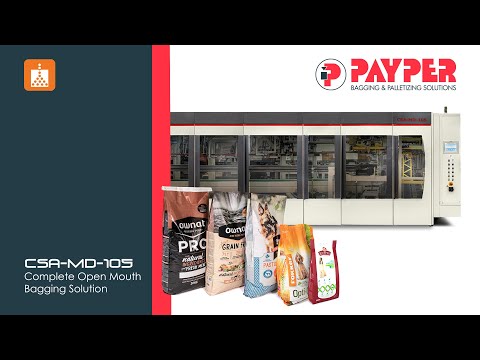
PAYPER was established in Spain in 1973, since then its clients, from multiple industries and especially from the PET FOOD sector, supported them with more than 450 projects with PAYPER technology in Latin America. From their headquarters in Mexico and Brazil, they offer a close service throughout the entire process: commercial, after-sales and spare parts. Among its countless solutions is the CSA automatic bagging machine, a modern and precise open-mouth bagging solution, suitable for the high standard requirements in the PET FOOD sector. It solutions adapts to the special conditions of each manufacturer: bag types, nature of the product and speed requirements. PAYPER is definitively an experts in new generation of packaging lines for bulk solids. We invite you to LEARN MORE about their equipment and solutions. By: All Pet Food
 Packaging
2+ MIN
13/04/2021
New Product - PAYPER presents new high-output FFS bagger
PAYPER has recently launched a new FFS bagging machine capable of filling up to 2,600 bags/hour. This bag filler, which is now the highest performing member of the FFS ASSAC-family, is called U20. It handles bags from 5 to 50 kg and works with tubular PE or Aluminium roll film with PE laminate and is especially suitable for bulk solids in granules. The ASSAC-U20 is specially designed for free flowing products such as plastic pellets, fertilizer prills, etc. Common demands when bagging this kind of products are output capacity, precision and reliability and the U20 meets all three. Five decades of experience and collaboration with the industry make PAYPER a trustworthy partner. Any new project is developed in close cooperation with the client and is tailor-made to suit each individual need. The ASSAC U20 is a flexible bagging solution that can be adapted to different requirements by adding modules such as Automatic roll film change; ATEX certification; Anti-corrosion kit; Cleaning system; Corner sealing system for optimal bag shape or a Movable platform. Additionally, a Metal-detector, Check-weigher or Ink-printer can be added to the line to customize the entire system for the user. Read more HERE ASSAC-U20. PAYPER's newest FFS bagging machine – 2,600 bags/h Bagging-line with PAYPER's new FFS bagger, 'ASSAC-U20' with a capacity of 2,600 bags/h. Features automatic roll film changer, metal detector and check weigher. Automatic film roll changer fitted to PAYPER's new FFS bagging machine 'ASSAC-U20'. PAYPER's high-speed FFS Bagging System, 'ASSAC-U20' with automatic film roll changer. Fuente: Payper
 Packaging
2+ MIN
03/11/2020
Automatic Bagging Specially Adapted to Industrial Mortars
'With the new installation, we managed together with PAYPER to have high-quality bagging for our markets, without compromising on productivity' NOVAMIX – DOMOCHEMICAL SA is a modern industry with great experience in the production of advanced building materials. The company offers integrated building systems that cover almost any application requirement in modern construction. The production facilities of NOVAMIX is based on the state-of-the-art production unit in Thiva, Greece, equipped with automated lines and an annual production capacity exceeding 100.000 tonnes of mortar. In 2007 DOMOCHEMICAL entrusted PAYPER to install their first automatic bagging line for bagging industrial mortars in valve bags. The line consisted of 2 spout air packers of the PFG-10 series with automatic bag placer CSV-1B, capable of producing 1.000 bags/hour (25 kg). Based on the smooth functioning of these two bagging spouts and the customer's satisfaction with the quality, reliability, bagging rate and accuracy, DOMOCHEMICAL decided to count on PAYPER again when the company expanded their production in 2019. This expansion involved: The increase in the factory's production with a new range of products to provide the market with completely closed, sealed bags. The solution was a new bagging line for packing industrial mortars in valve bags and seal these with an ultrasonic sealing system. The line was composed by 2 automatic air packers of the PFG-10 series featuring the ultrasonic sealing system, 'STV'. The new line is prepared to be upgraded in future with an additional third filling spout. The current capacity with sealing valve is 600 bags/hour and 700 bags/hour (without sealing valve). When a third filling spout is added the capacity is increased to 900 bags/hour with valve sealing and 1050 bags/hour (without valve sealing). Customer testimonials 'PAYPER had an advantage to be selected again for our new investment, as they had already proven their quality – a pair of machines working fine for almost 13 years, simple, durable and reliable, with components of high quality together with a friendly and accurate technical support,' says NOVAMIX. 'Having the two machines side by side, old and new, it is impressive to see how much PAYPER is indeed evolving, applying best practices from the field, bringing new features on the machines. We had a very smooth project, well prepared in advance. PAYPER's PFG-10, automatic air packer with ultrasonic valve sealing Although the startup took place during a very difficult period with the corona-virus uprising, when needed the customer service of PAYPER proved to be of high-class, based on availability and knowledge. Internet of Things is not just a wish, the machines are connected to the web and PAYPER'S technical service can have a live overview when needed. With the new installation, we managed together with PAYPER to have high-quality bagging for our markets, without compromising on productivity. Well done PAYPER!' by Payper
 Packaging
2+ MIN
27/10/2020
Full line Bagging and Palletizing Solution that Fulfills Future Needs
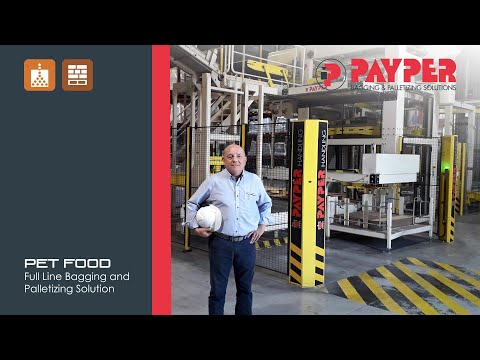
ACA, one of Argentina's main Pet food Manufacturers, decided to install new technology in their production line, as the old manual bagging system had become a bottleneck in the production line. The company has a wide variety of extruded products with kibble sizes ranging from 2.0 mm diameter up to 16.0 mm diameter x 26 mm long, with an ethereal extract from 4.0% up to 30.0%. The bag-types are numerous as well: Open mouth paper bags and open mouth plastic bags with or without micro-perforation, with 4 seams, pillow type or laminated with metal. The production rate of the new system should be capable of reaching 1.000 bags of 15 kg per hour. Further, it should be easy to switch between different bag sizes, from 8 to 30 kg and between different closure systems such as heat sealing, stitching and sew-through tape closure. ACA investigated the market and visited different installations and finally decided on PAYPER for several reasons: Precise, well-functioning, and accurate machines that would fulfill future needs. PAYPER has representation in Argentina and technical service in Brazil. Together ACA and PAYPER designed the new end-of-line solution, assuring that all the demands were taken into consideration. Requirements to the new End of Line solution: Precision and accuracy The capacity of 1.000 bags/h Ability to work with a variety of kibbles Must handle different bag materials and sizes The system comprises a CSA-105 open-mouth bagging machine and a TOPLOAD palletizer. Mr. Roberto Chunco, Head of ACA's Feed Plant in front of the high capacity automatic palletizier 'The commissioning of the installation was handled in a very professional way with thorough training of the operators. Whenever we have needed PAYPER`s After Sales Service the response has been optimal. Since the installation in May 2017, the bagging line has proved its worth. The goal of manufacturing has been fulfilled, we have obtained the expected savings, and the presentation and the finishing of the bag are of top-quality, ready for retail. ' Mr. Roberto Chunco, Head of the Feed Plant. 'The replacement, in addition to automating allowed us significant cost savings and improvements in the final presentations of our products.' Mr Walter Brignoli, General Manager of the Feed Factory. 'One of the greatest satisfactions is the precision of the weighing and dosing system and the speed with which it is done' Mr José Sejas, End of Line Coordinator, Responsible for operation and maintenance. by Bulk Inside
 Packaging
1+ MIN
13/04/2020
PAYPER - Brand new Office in Bangkok
PAYPER has just opened its 6th subsidiary, this time in Bangkok, Thailand. The new branch, PAYPER Asia Pacific, will service all clients in the Far East and Pacific regions. 'The increasing demand for bagging and palletizing solutions in this area, has made us establish a branch to attend directly to all sales and service matters in the region,' says PAYPER's sales director Mr Jacky Fricker. 'It is with great enthusiasm that we open our new office here. It underlines PAYPER's will to be near the client to quickly attend to any sales or service query he may have. We want to shorten the lines of communication with our clients, and we believe that establishing ourselves directly in the region is the best way to meet our customers' expectations.' Mr Piti Lertbusayanukul has been appointed as Field Sales Manager in the new subsidiary. He will be the daily leader of the subsidiary and coordinate all sales and service actions in the area. He can be reached directly on e-mail: Piti.Lertbusayanukul@payper.asia by Payper
Videos
Next videos
Next videos