4 min reading
By María Candelaria Carbajo
Wednesday, 15 of June, 2023Clean labels: the bridge to a more transparent industry
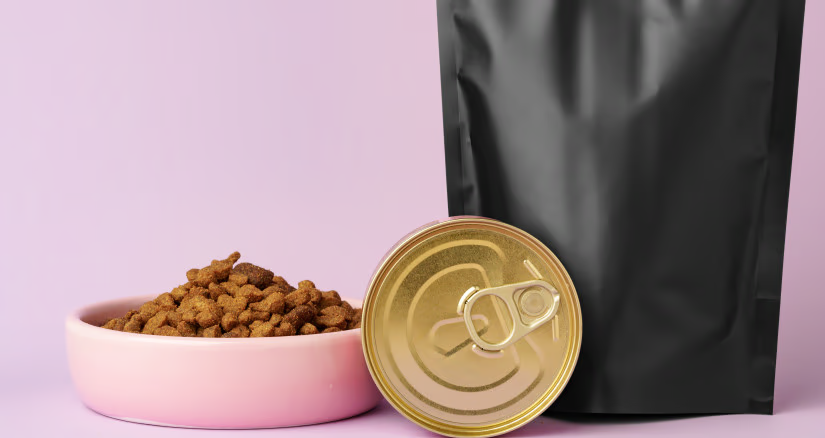
The new and increasingly established trend of clean labels in pet food is undoubtedly a challenge for manufacturers, not only in the design of their packaging but also in improving their products so that they are stable, nutritious, and safe with a limited range of ingredients.
The new and increasingly established trend of clean labels in pet food is undoubtedly a challenge for manufacturers, not only in the design of their packaging but also in improving their products so that they are stable, nutritious, and safe with a limited range of ingredients.

In recent years, consumers have become much more conscious about the care of their pets and, consequently, about the products they offer for their nutrition. The industry, then, has to ensure its products are of good quality and made with ingredients that people easily accept when reading the labels.
What are we talking about when we talk about clean labels?
When pet owners read, a few years ago, the ingredients on the pet food labels they chose, they used to find, for the most part, complex terms that made them lose confidence about the quality of said food for their pets. Today, with this trend, we are facing a slow and progressive change, which jeopardizes what has been sustained up to now and requires the industry to offer new alternatives. Thus, the clean-label trend arises to calm people's fear of harmful chemical equations, incomprehensible terms, and complex compositions.
It's all about perception
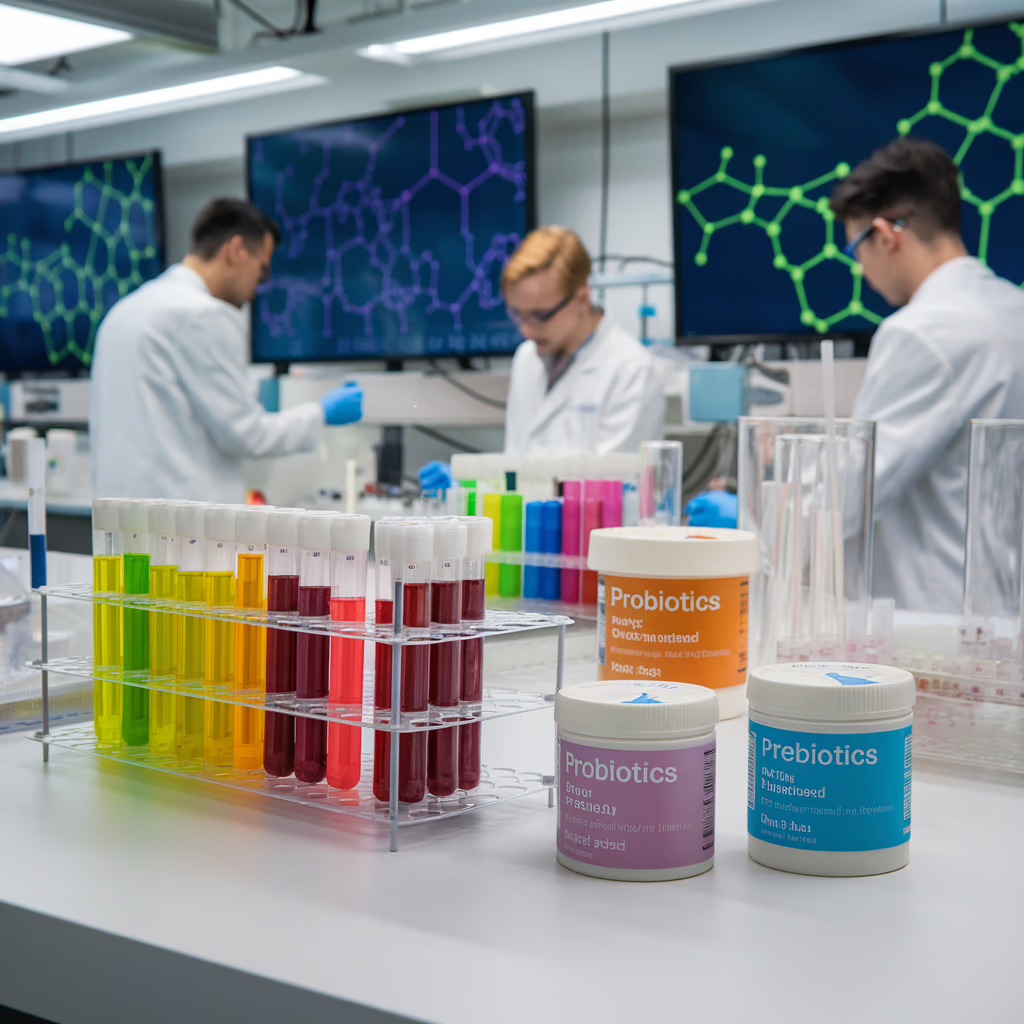
One of the most significant challenges facing this trend is that there is no single perception of what clean-label food really is. While we all understand that it would be a transparent and easy-to-understand label, for some consumers it may mean short and simple recipes with few synthetic vitamins, preservatives, and other artificial ingredients. For others, it may be discovering a product made from 100% natural ingredients with no artificial preservatives, non-grain carbohydrate sources, non-GMO ingredients, natural colors and flavors, limited ingredient diets, by-product-free protein sources, vegan ingredients, or locally sourced, for example.
According to reports from the International Food Information Council (IFIC), almost 2 out of 3 participants believe ingredients influence their purchasing decisions.
Meanwhile, according to a BIS Research study, the global market for clean-label ingredients was valued at $19.77 billion in 2020, and it's expected to reach $32.08 billion by 2026. With these predictions, it is clear that clean-label ingredients are the food industry's alternative to the growing consumer demand for consumables without questionable ingredients.
The importance of clean labels (and their ingredients)
The transparency of the ingredients and their description on the labels lies in openly sharing the sources of the substances used in food and the practices followed to obtain them. Today's consumers know they have the right to know all the information they want about food ingredients.
The plain consequence of this market demand is a late increase in sales of organic products and a decrease in processed foods or foods with artificial additives. This, in turn, is reflected in 'free from' style labels or stamps on product packaging that have had to be reformulated to come as close to natural as possible, avoiding adulterated or artificial ingredients as much as possible.
In this sense, new technologies and food science are playing a significant role in helping manufacturers innovate their solutions to go to market with more transparent products and labels.
Clean-label challenges
Inevitably, to ensure clean label ingredients maintain and expand their reach, flavor, and product developers began paying more attention to nutritional profiles.
Leaving the known behind
Some formulas will be easier to modify and adjust than others. Transforming a current product may require various adjustments and validation processes, since changing preservatives is not the same as eliminating, for example, a main source of protein or carbohydrates. In many cases, what begins as a small modification ends in a product requalification and almost a total redesign.
For other ingredient categories, such as colorants, the alternatives may be limited. However, we already find companies working on finding solutions to this challenge. Color additive suppliers are already developing natural alternatives to currently certified pigments, such as caramel colorants which, while perfectly compliant with the clean-label category, only achieve a certain level of darkness.
Naming what is needed
Another industry challenge is related to the vitamins, minerals, and other nutrients necessary for a complete and balanced pet diet. Most owners prefer ingredients they recognize and can pronounce, which is why the most difficult ingredients to tackle are vitamins and minerals, but the truth is that pets require them, as well as specific bioavailable fatty acids and amino acids for a complete and healthy diet. In this regard, the AAFCO requires that supplemental vitamins and minerals are included in the packages with the approved names, and although some may be difficult to recognize, perhaps the best option, in this case, is to educate people on their importance.
On the other hand, we can mention the difficulty that arises when it comes to achieving a clean label on wet foods since these usually contain guar, cassia, or xanthan hydrocolloids, carrageenan, or carob, profitable alternatives to achieve the proper viscosity in these foods. However, with the increase in demand for natural and recognizable ingredients in packaging, more and more manufacturers are looking to replace these gums with clean-label ingredients, such as rice starch.
Challenge accepted: clean and transparent labels (and products)
Reformulating a pet food product to meet clean-label criteria can take considerable time to have it validated and ready for launching to the market. New ingredient qualification, establishing long-term viable material supply chains, and quality control validation of the final product design are some of the critical steps that affect the redesign process.
The positive thing about this request for ingredients that satisfy the demanding preferences of new pet owners is that it has allowed industry suppliers to innovate and work to offer healthier and more transparent solutions.
Source: All Pet Food Magazine
You could be interested: Understanding Pet Food Labels

About the author
María Candelaria CarbajoI’m a creative, interdisciplinary person, translator, and editor. I collaborate in producing and writing creative, high-impact projects to promote cultural exchange, transmit differential values, and connect with people/the audience. Likewise, I enjoy teamwork and joining forces, experiences, and knowledge to bring the world all the potential of those ideas that seek to impact people’s lives positively.

Labels



Events

IBERZOO PROPET
11 to 13 March, 2026
Madrid, España
https://www.ifema.es/iberzoo-propet

Simposio CS Petfood & Aquafeed
15 to 16 April, 2026
Pilar, Buenos Aires, Argentina
https://www.cliviosolutions.com/

PET FOOD FORUM KANSAS
27 to 29 April, 2026
Kansas City, Missouri, USA
https://www.petfoodforumevents.com/

interpack
07 to 13 May, 2026
Düsseldorf, Alemania
https://www.interpack.com/

Smart Pet Food Production
11 May, 2026
Sheraton Carlton Nürnberg
https://www.petfoodcompetencenet.com/events/
Interzoo 2026
12 to 15 May, 2026
Nuremberg, Germany
https://www.interzoo.com/en

FENAGRA 2026
12 to 14 May, 2026
Santana – São Paulo
https://www.fenagra.com.br/

XXIV CONGRESO DE PET DE LA CBNA
12 to 14 May, 2026
São Paulo Expo, Brasil
https://www.fenagra.com.br/congresso/cbna-pet/

EXPO PACK México 2026
02 to 05 June, 2026
Ciudad de México, CDMX.
https://www.expopackmexico.com.mx/

VICTAM 2026
02 to 04 June, 2026
Utrecht, Países Bajos
https://victaminternational.com/

VIV Europe 2026
02 to 04 June, 2026
Utrecht, the Netherlands
https://www.viveurope.nl/

Foro Mascotas 2026
24 to 26 June, 2026
Expo Guadalajara, Mexico
https://www.foromascotas.mx/en

Pet South America 2026
12 to 14 August, 2026
São Paulo Expo, Brazil
https://petsa.com.br/

Pet Fair Asia 2026
19 to 23 August, 2026
Shanghai, China
https://en.petfairasia.com/

CIPAL 2026
23 to 24 September, 2026
Buenos Aires, Argentina
https://cipal.com.ar/?lang=en

PETZOO Eurasia
07 to 10 October, 2026
İFM- İstanbul Expo Center
https://petfuari.com/en/

SINPET 2026
15 to 16 October, 2026
Porto Alegre, Brazil
https://www.instagram.com/sinpet2026/

FIGAP 2026
21 to 23 October, 2026
Guadalajara, Jalisco, Mexico
https://figap.com/

Pet Fair South East Asia
28 to 30 October, 2026
Bangkok, Thailand
https://petfair-sea.com/
Advertising