4 min reading
Does Dog Food Expire? How to Know If Your Pet’s Food Has Gone Bad
Has your dog started turning their nose up at the dinner they usually scarf down? While it’s always a good idea to contact your vet if your dog is refusing meals, consider the freshness of their food —it might be past its prime.
Has your dog started turning their nose up at the dinner they usually scarf down? While it’s always a good idea to contact your vet if your dog is refusing meals, consider the freshness of their food —it might be past its prime.
Expiration or sell-by dates can offer some guidance, but how and where you store your dog's food will have a greater effect on its shelf life, says Dr. Jennifer Larsen, DVM, Ph.D., DACVIM, Professor of Clinical Nutrition and Service Chief at the UC Davis Veterinary Medical Teaching Hospital.
'Some people can smell rancidity quite easily, and other people can't,' Dr. Larsen says. With their extremely sensitive noses, dogs are likely to detect spoilage before you do. 'If you're smelling that the food smells 'off,' then your pet is definitely noticing.'
How to Tell if Your Dog's Food Has Spoiled
Most dog food manufacturers will include an expiration date or a sell-by date on their packaging, but individual companies may have their own definitions or guidance for these terms. In general, expiration dates advise when food is no longer safe to eat, whereas terms like 'sell by' or 'best if used by' indicate when the unopened food might start to deteriorate in quality.

'Dogs and cats have much more sensitive noses than we do, and they have very strong opinions about the way that their food tastes,' Dr. Larsen says. If your dog seems reluctant to eat, sniffs their food for longer than usual, or just lacks excitement around mealtime, they could be detecting less appetizing flavors or odors due to spoilage.
If you find evidence of pest infestation, such as ants or rodent droppings, discard the food —even if it's well within the sell-by date. This food is neither safe nor palatable for your dog.
Storing Dry Dog Food
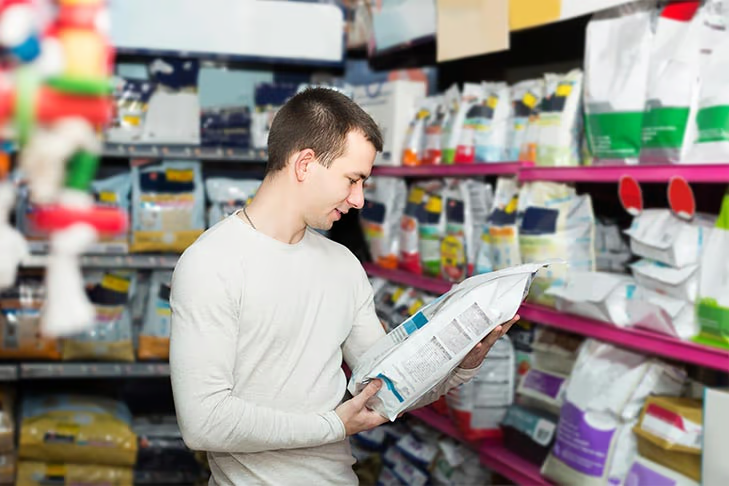
To preserve freshness, Dr. Larsen recommends keeping kibble in its original packaging, in a cool, dry area of your home where the temperature stays consistent.
'You would be amazed at how much effort goes into pet food packaging,' Dr. Larsen says, adding that it's one of the more expensive parts of commercial pet food production. Manufacturers engineer the bags to prevent fat migration and oxidation, the primary culprits in rancidity.
Even though pet food packaging isn't airtight or watertight, Dr. Larsen advises against transferring food from its original packaging into a separate storage container or zip-close bag.
'First of all, you're exposing all the food in the bottom of the bag to air and light —and air and light are definitely the enemies here,' Dr. Larsen explains. 'You're also potentially putting it into a secondary container that itself might impart odors and taste to dry foods that can adversely affect palatability.'

For added protection, Dr. Larsen says owners can place the entire bag of food —sealed, and in its original packaging— into a secondary container. Bags without a self-sealing feature should be folded down and secured with a bag clip.
'You're trying to minimize exposure to air, and you don't want as much airspace between the top of the kibble and the top of the bag,' she says.
Keeping Canned Dog Food Fresh
Canned food is sterilized as it's cooked in the can, so sealed food should be stable for a very long time. But the same storage considerations apply as with dry food —keep the cans in a cool, dry place in your home, away from heat and fluctuating temperatures. Check for dents before serving, especially along the seams on the top and bottom of the can. If the can is dented or ruptured, discard the food.
Once cans are open, they should be covered and refrigerated. 'Using a lid, or a plastic wrap, or something like that over the top, and then using that within five days or so is probably fine,' explains Dr. Larsen.
Risks of Eating Expired Dog Food
Dry dog food that is exposed to air over time undergoes a chemical process called lipid oxidation, which breaks down the fat molecules and causes rancidity. Diets high in unsaturated fat, such as those that contain fish oils, 'are going to be more sensitive to those oxidation damages that are going to happen just from exposure to air,' Dr. Larsen says.
Most commercial pet foods are formulated with enough nutrient overages that it's unlikely a dog will experience nutritional deficiencies from eating stale food, Dr. Larsen says. But when fat oxidation occurs, essential fatty acids are damaged and can cause gastrointestinal issues.
'[Oxidation products] definitely upset the bacteria that live in our gastrointestinal tract, and some of those oxidation products that happen are considered toxic,' Dr. Larsen says. 'So not only do they not taste good, they can cause diarrhea and things like that.'
Beyond oxidation, very old or stale food may have diminished nutritional value, such as vitamin loss. 'You could theoretically see some deficiencies,' Dr. Larsen says, 'but I would expect that, unless it was a dire circumstance, the pet would stop eating the food before it became quite spoiled.'
By Lindsey Dobruck
Source: American Kennel Club

You could be interested: The Growing Weight of Love: Why Our Pets Are Facing an Obesity Epidemic


Events

IBERZOO PROPET
11 to 13 March, 2026
Madrid, España
https://www.ifema.es/iberzoo-propet

Simposio CS Petfood & Aquafeed
15 to 16 April, 2026
Pilar, Buenos Aires, Argentina
https://www.cliviosolutions.com/

PET FOOD FORUM KANSAS
27 to 29 April, 2026
Kansas City, Missouri, USA
https://www.petfoodforumevents.com/

interpack
07 to 13 May, 2026
Düsseldorf, Alemania
https://www.interpack.com/

Smart Pet Food Production
11 May, 2026
Sheraton Carlton Nürnberg
https://www.petfoodcompetencenet.com/events/
Interzoo 2026
12 to 15 May, 2026
Nuremberg, Germany
https://www.interzoo.com/en

FENAGRA 2026
12 to 14 May, 2026
Santana – São Paulo
https://www.fenagra.com.br/

XXIV CONGRESO DE PET DE LA CBNA
12 to 14 May, 2026
São Paulo Expo, Brasil
https://www.fenagra.com.br/congresso/cbna-pet/

EXPO PACK México 2026
02 to 05 June, 2026
Ciudad de México, CDMX.
https://www.expopackmexico.com.mx/

VICTAM 2026
02 to 04 June, 2026
Utrecht, Países Bajos
https://victaminternational.com/

VIV Europe 2026
02 to 04 June, 2026
Utrecht, the Netherlands
https://www.viveurope.nl/

Foro Mascotas 2026
24 to 26 June, 2026
Expo Guadalajara, Mexico
https://www.foromascotas.mx/en

Pet South America 2026
12 to 14 August, 2026
São Paulo Expo, Brazil
https://petsa.com.br/

Pet Fair Asia 2026
19 to 23 August, 2026
Shanghai, China
https://en.petfairasia.com/

CIPAL 2026
23 to 24 September, 2026
Buenos Aires, Argentina
https://cipal.com.ar/?lang=en

PETZOO Eurasia
07 to 10 October, 2026
İFM- İstanbul Expo Center
https://petfuari.com/en/

SINPET 2026
15 to 16 October, 2026
Porto Alegre, Brazil
https://www.instagram.com/sinpet2026/

FIGAP 2026
21 to 23 October, 2026
Guadalajara, Jalisco, Mexico
https://figap.com/

Pet Fair South East Asia
28 to 30 October, 2026
Bangkok, Thailand
https://petfair-sea.com/
Advertising