4 min reading
By María Candelaria Carbajo
Thursday, 08 of January, 2024How do we create a circular food industry?
The circular economy applied to animal feed reframes the conversation about sustainability. Food systems of this type require less land and can produce fewer greenhouse gas emissions. But how do we achieve a more circular pet food production?
The circular economy applied to animal feed reframes the conversation about sustainability. Food systems of this type require less land and can produce fewer greenhouse gas emissions. But how do we achieve a more circular pet food production?

Focused on the pet food industry, this production model aims to minimize food waste as much as possible by maximizing the use of co-products, such as feeding livestock. Today it is already known that the optimal use of ecological remains requires animals that consume them with bodies capable of converting said remains into new food of animal origin. The proposal underlying the initiatives is to stop seeing certain by-products, such as meat ones, as 'waste' and begin to perceive them as a source of food or nutrients for certain animals or stages of a food production chain.
But what else can be done to minimize food waste and promote fully circular global food systems? Industry experts say it is about optimizing both information and supply chains. Various organizations are researching how to turn food waste into animal feed, as 14.7 million tons could be safely used for animal feed instead of going to landfills only in the United States.
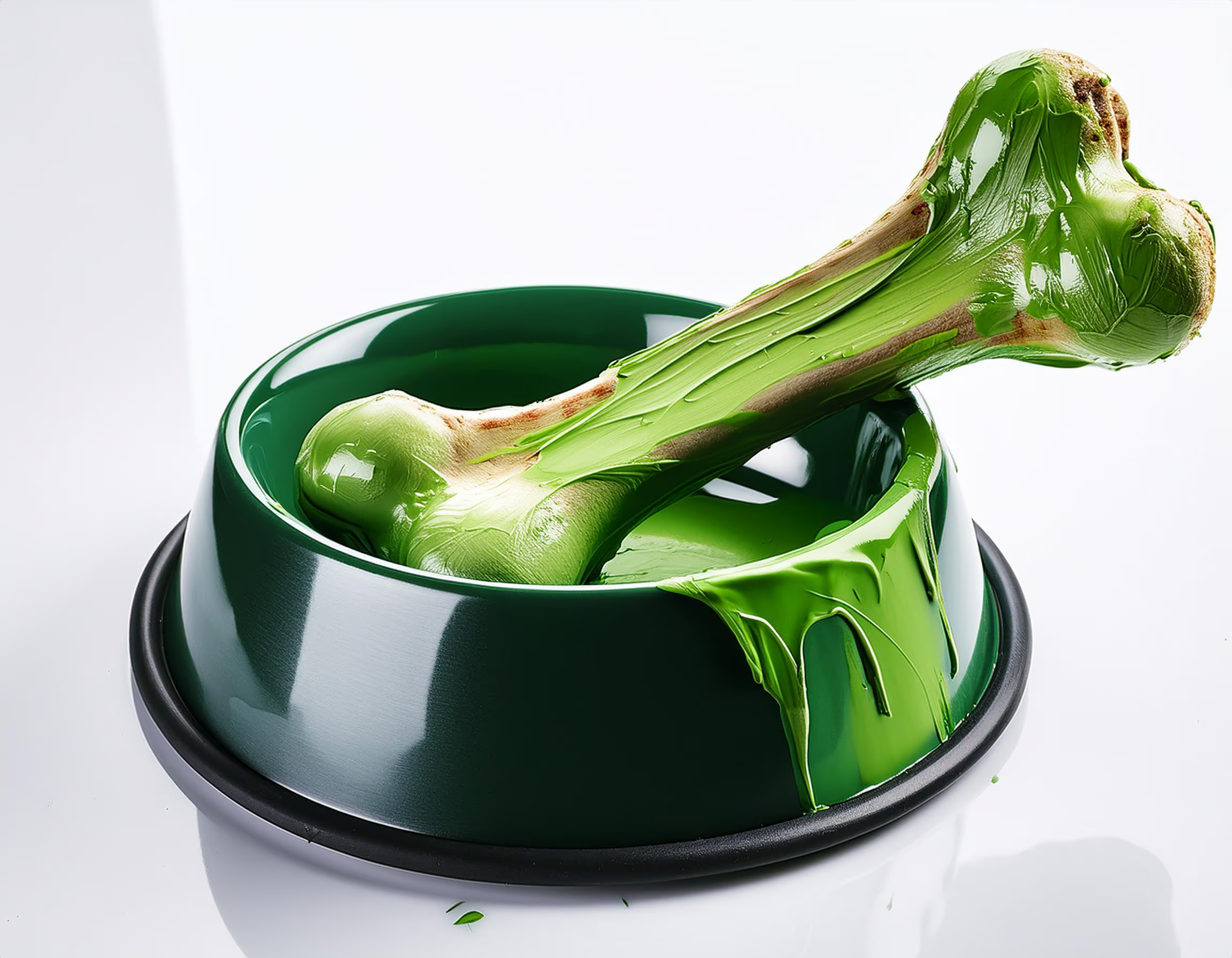
In the case of pigs, for instance, they have a large stomach, which allows them to turn food by-products and waste into meat, while ruminants can turn grasslands into milk and meat. On the other hand, poultry is possible by-product converters in meat and eggs, but they require a high-quality intake to achieve it. Many environmentalists also see potential benefits in a circular food system that recycles potential waste products through livestock production.
For its part, the Food and Agriculture Organization of the United Nations (FAO) estimates that more than 13% of world food production loses between the production and wholesale stages of the supply chain, with an additional 17% wasted in the final sale instance to the final consumer. Additionally, food loss and waste contribute between 8% and 10% of global greenhouse gas emissions. 'We need to work on recovering resources for circular food production.'
'We need to work on recovering resources for circular food production.'
Booming Trends
Some aspects of circular feeding could be seen as in full swing, such as the rise of interest in insects as a source of protein, algae, and even single-celled organisms to recover an even higher percentage of nutrients from produce that might, otherwise, be lost.
The truth is that, in general terms, a great openness is easily perceived on the part of livestock producers and breeders in general, who tend to be predisposed to adopt any safe, effective, and affordable ingredient. Therefore, increasing the adoption of circular feeding systems depends, to a large extent, on factors such as accessibility.
However, nutrient recovery is not new in animal feed. Recycling waste from food processing and other industries to create feed ingredients is critical, and repurposed feed, which would otherwise be inedible to humans, provides a cost-effective alternative to traditional, resource-intensive raw materials. Working in circularity directly impacts on:
People
Currently, less than 2% of valuable nutrients are recycled in food by-products and waste. By reusing them as fertilizer, animal feed, or raw materials for textiles and plastics, we can spur innovation, open new ways for business, and reduce environmental damage. This shift towards resource utilization presents immense opportunities for sustainability, employment, and economic prosperity.
Nature
We need to redirect the industry toward regenerative food production. For that, we should re-evaluate what and how we grow. Currently, more than 75% of food derives from only 12 plant and five animal species due to agricultural industrialization. Failure to address this problem will have profound consequences both for human and planet health.
By diversifying farming systems and ensuring a symbiotic relationship with nature, we can mitigate these risks and foster a more sustainable and resilient future.
Weather
Minimizing food loss and waste is crucial. At all stages, from field to table, much food is discarded nowadays. If food waste were a country, it would rank as the third largest emitter of greenhouse gases worldwide! By addressing this issue, we can make significant progress in mitigating climate change and creating a more sustainable future.
It is about placing more and more emphasis on circularity in food systems to minimize waste and create a closedloop model where all resources are used efficiently and sustainably. In this paradigm, waste from one stage of the food supply chain would be reused as a resource for another, creating a continuous cycle of use and reuse.
'Unleashing the potential of commonly wasted resources is essential and urgent.'
Will we be able to create a circular economy for our industry?
The waste generated by society will decrease in response to climate change and food insecurity. For that, we need to start considering new alternatives.
Today, the pet food industry already belongs to a circular economy in which some leftovers from the human food industry are used. That is an efficient way of using the planet's resources. But more education is needed to highlight these efforts and improve circularity connections. If we work for it, future generations will count on an efficient and responsible animal agriculture industry concerning the environment and its resources.
By All Pet Food Magazine.
You could be interested: Sustainability Trends In The Pet Industry

About the author
María Candelaria CarbajoI’m a creative, interdisciplinary person, translator, and editor. I collaborate in producing and writing creative, high-impact projects to promote cultural exchange, transmit differential values, and connect with people/the audience. Likewise, I enjoy teamwork and joining forces, experiences, and knowledge to bring the world all the potential of those ideas that seek to impact people’s lives positively.


Events

IBERZOO PROPET
11 to 13 March, 2026
Madrid, España
https://www.ifema.es/iberzoo-propet

Simposio CS Petfood & Aquafeed
15 to 16 April, 2026
Pilar, Buenos Aires, Argentina
https://www.cliviosolutions.com/

PET FOOD FORUM KANSAS
27 to 29 April, 2026
Kansas City, Missouri, USA
https://www.petfoodforumevents.com/

interpack
07 to 13 May, 2026
Düsseldorf, Alemania
https://www.interpack.com/

Smart Pet Food Production
11 May, 2026
Sheraton Carlton Nürnberg
https://www.petfoodcompetencenet.com/events/
Interzoo 2026
12 to 15 May, 2026
Nuremberg, Germany
https://www.interzoo.com/en

FENAGRA 2026
12 to 14 May, 2026
Santana – São Paulo
https://www.fenagra.com.br/

XXIV CONGRESO DE PET DE LA CBNA
12 to 14 May, 2026
São Paulo Expo, Brasil
https://www.fenagra.com.br/congresso/cbna-pet/

EXPO PACK México 2026
02 to 05 June, 2026
Ciudad de México, CDMX.
https://www.expopackmexico.com.mx/

VICTAM 2026
02 to 04 June, 2026
Utrecht, Países Bajos
https://victaminternational.com/

VIV Europe 2026
02 to 04 June, 2026
Utrecht, the Netherlands
https://www.viveurope.nl/

Foro Mascotas 2026
24 to 26 June, 2026
Expo Guadalajara, Mexico
https://www.foromascotas.mx/en

Pet South America 2026
12 to 14 August, 2026
São Paulo Expo, Brazil
https://petsa.com.br/

Pet Fair Asia 2026
19 to 23 August, 2026
Shanghai, China
https://en.petfairasia.com/

CIPAL 2026
23 to 24 September, 2026
Buenos Aires, Argentina
https://cipal.com.ar/?lang=en

PETZOO Eurasia
07 to 10 October, 2026
İFM- İstanbul Expo Center
https://petfuari.com/en/

SINPET 2026
15 to 16 October, 2026
Porto Alegre, Brazil
https://www.instagram.com/sinpet2026/

FIGAP 2026
21 to 23 October, 2026
Guadalajara, Jalisco, Mexico
https://figap.com/

Pet Fair South East Asia
28 to 30 October, 2026
Bangkok, Thailand
https://petfair-sea.com/
Advertising