4 min reading
Odor control technologies comparison
Currently, countries are acting more rigorously on caring for the environment based on different established measures. A clear example is the regulation of odors emitted into it from industrial processes.
Governments or environmental entities are not the only ones that require compliance with laws to control industrial odors. Nowadays, society plays a key role in public opinion when it comes to the Earth, its care, and pollution. There are various technologies with their advantages and disadvantages and with different functions for odor control.
Currently, countries are acting more rigorously on caring for the environment based on different established measures. A clear example is the regulation of odors emitted into it from industrial processes.
Governments or environmental entities are not the only ones that require compliance with laws to control industrial odors. Nowadays, society plays a key role in public opinion when it comes to the Earth, its care, and pollution. There are various technologies with their advantages and disadvantages and with different functions for odor control.
Biofilter Technology
Process air, which contains an annoying odor, is treated using a filter material, normally woodchips, and eliminated by microorganisms located therein, and can reduce various compounds such as sulfides, ammonia, and amines when present in low concentrations. Then, the clean air is released into the atmosphere, leaving the residual drainage (nitrates and sulfides) as a contaminant that must necessarily be treated, because, otherwise, they continue to cause negative odors.
This system can treat flows of 1,000 to 50,000 m3/h, and requires water for its operation and a large area for its implementation, using little electrical energy. To avoid damaging the filter material, periodic maintenance should be considered. When it comes to processing air with a high dust content, it is mandatory and necessary to treat it, for example, using a gas scrubber.

It is considered a good technology due to its cost/efficiency ratio, obtaining results with up to 85% of odors eliminated. Regarding investment costs, and even though they may vary by brand, manufacturer, or model, those generally range between USD 700,000 and USD 1,000,000.
Ozone and UV Light Treatment Technology
Airflow, which must be less than 20,000 m3/h, first passes through the UV lights, where the ammonia, sulfides, and amines are decomposed, and then the remaining compounds are broken down with catalysts by injecting ozone (O3).
Removing dust from the air during the process is crucial as it will damage the effectiveness of the UV light. That is, highly contaminated air can considerably affect the efficiency of the system due to the flow density.
On the other hand, it uses electrical energy for its operation, and the air must either not exceed 60°C or the humidity be greater than 85%. This treatment allows good results, reaching levels of 70 to 90%. In this case, investment costs are considered between USD 200,000 and USD 400,000, with high annual operating costs.
Non-thermal Plasma (NTP) Technology
Technology capable of treating flows ranging from 5,000 m3/h to 250,000 m3/h depends on the system: in the case of direct NTP, normally 20,000 m3/h can be treated, but it could be up to 250,000 m3/h with indirect NTP. These devices use ambient air to generate free or active oxygen (O1), which has a high oxidation power with the molecules that contain the annoying odor. To obtain them, the air must pass through a stage of filters to rid them of impurities and then go through the cabinet with non-thermal plasma modules, where the dissociation of the molecules is achieved, and the aforementioned oxygen radicals are obtained. These are injected into the outlet duct where the annoying odors come from, and in just 1 second, the odor molecules react and oxidize, becoming imperceptible to our noses.

Unlike other technologies, non-thermal plasma does not use water or chemicals for its operation, so it does not generate a secondary contaminated by-product. It only requires a minimum of electrical energy. In addition to the large flow rates it can manage, there is no restriction on the humidity or temperature that the process air can have.
Optimal results are achieved, reaching up to 95% of odors eliminated.
These systems easily adapt to existing installations, thanks to their flexibility and the little space they take up. Regarding investment levels, these range from EUR 120,000 to EUR 250,000.
Scrubber technology
The air coming from the process, which contains the annoying odor, comes into contact with the stream of water and drip-type chemicals. This way, the odors react or are dissolved into the liquid and the air is released into the atmosphere clean.
Scrubbers, also known as gas scrubbers, can treat air flows that contain dust without using filters. They can treat flows ranging from 1,000 to 60,000 m3/h, achieving good results from 50% to 70% of controlled odors.
A great disadvantage of this system is that strict control of the contaminated water generated after the process is required, and it also occupies a large area for its installation.
The investment can reach up to USD 500,000 with high operating costs of up to USD 150,000 per year.
Conclusion
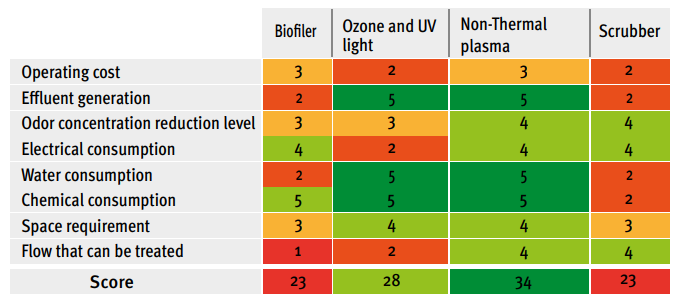
As a summary, see a comparative table of the technologies presented with their advantages and disadvantages, considering the following as a score: 5 highly positive, 4 positive, 3 medium, 2 negative, and 1 highly negative.
The choice and installation of the appropriate system will depend, on the one hand, on the industrial process that needs to be treated, considering the components of the contaminated air, and, on the other hand, on the levels of odor control that must be achieved to comply with current regulations in each country.
By: Clivio Solutions.
Source: All Pet Food Magazine.
You could be interested: Efficiency, Precision, and Adaptability: Key Factors in Modern Pet Food Packaging


About the company
About the company
At Clivio Solutions, we offer engineering services and high-level consulting, specializing in balanced food. Our experience enforces with prestigious associations, ensuring security, cutting-edge technology, and intelligent and sustainable solutions.
Our value proposition is based on integrity, a wide range of solutions, and a broad geographic breadth. We stand out for encouraging synergy being dedicated facilitators who offer continuous support characterized by unequaled reliability and quality.


17/12/2024
The Evolution of the Pet Food Industry: Modernization and Automation of Plants
17/12/2024
The Evolution of the Pet Food Industry: Modernization and Automation of Plants
Events

IBERZOO PROPET
11 to 13 March, 2026
Madrid, España
https://www.ifema.es/iberzoo-propet

Simposio CS Petfood & Aquafeed
15 to 16 April, 2026
Pilar, Buenos Aires, Argentina
https://www.cliviosolutions.com/

PET FOOD FORUM KANSAS
27 to 29 April, 2026
Kansas City, Missouri, USA
https://www.petfoodforumevents.com/

interpack
07 to 13 May, 2026
Düsseldorf, Alemania
https://www.interpack.com/

Smart Pet Food Production
11 May, 2026
Sheraton Carlton Nürnberg
https://www.petfoodcompetencenet.com/events/
Interzoo 2026
12 to 15 May, 2026
Nuremberg, Germany
https://www.interzoo.com/en

FENAGRA 2026
12 to 14 May, 2026
Santana – São Paulo
https://www.fenagra.com.br/

XXIV CONGRESO DE PET DE LA CBNA
12 to 14 May, 2026
São Paulo Expo, Brasil
https://www.fenagra.com.br/congresso/cbna-pet/

EXPO PACK México 2026
02 to 05 June, 2026
Ciudad de México, CDMX.
https://www.expopackmexico.com.mx/

VICTAM 2026
02 to 04 June, 2026
Utrecht, Países Bajos
https://victaminternational.com/

VIV Europe 2026
02 to 04 June, 2026
Utrecht, the Netherlands
https://www.viveurope.nl/

Foro Mascotas 2026
24 to 26 June, 2026
Expo Guadalajara, Mexico
https://www.foromascotas.mx/en

Pet South America 2026
12 to 14 August, 2026
São Paulo Expo, Brazil
https://petsa.com.br/

Pet Fair Asia 2026
19 to 23 August, 2026
Shanghai, China
https://en.petfairasia.com/

CIPAL 2026
23 to 24 September, 2026
Buenos Aires, Argentina
https://cipal.com.ar/?lang=en

PETZOO Eurasia
07 to 10 October, 2026
İFM- İstanbul Expo Center
https://petfuari.com/en/

SINPET 2026
15 to 16 October, 2026
Porto Alegre, Brazil
https://www.instagram.com/sinpet2026/

FIGAP 2026
21 to 23 October, 2026
Guadalajara, Jalisco, Mexico
https://figap.com/

Pet Fair South East Asia
28 to 30 October, 2026
Bangkok, Thailand
https://petfair-sea.com/
Advertising