3 min reading
Protein digestibility kinetics: A key criterion for discriminating between protein sources in pet food (Part 1)
The potential of a specifically designed hydrolyzed yeast.
The potential of a specifically designed hydrolyzed yeast.
Introduction
The search for innovative protein sources is on the rise as a result of increasing global food consumption and consumer concerns about sustainability, animal welfare, and strain on agricultural land. In line with the humanization trend, pet owners are likely to select a pet food based on their own dietary preferences. Moreover, the increased awareness of the importance of proper nutrition has led pet owners to become more and more careful when looking at pet food labels. Clean label is amongst the top trends in the pet food market and seems to be driven by the perceived link between health and naturalness. Consequently innovative protein sources are of great interest in the Pet Industry as a way to meet the growing market demand for pet nutrition.
Proteins: The importance of digestibility and absorption kinetics

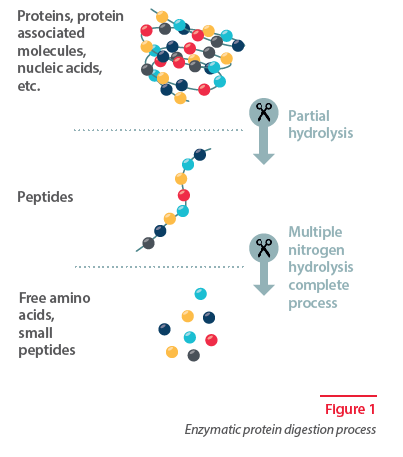
Proteins are biological macromolecules made up of amino acids. Protein bioavailability is strongly related to its amino acid composition, size, and mass range. Big proteins, proteinassociated molecules and nucleic acids have lower digestibility compared to free amino acids and small peptides, which have been exposed to a multiple nitrogen hydrolysis process that makes them more bioavailable (Figure 1).
The digestion process is complex. It is driven by enzymatic activities and is pH dependent. In monogastric animals, this process starts in the stomach where protein denaturation occurs due to pepsin activation. In the duodenum, pancreatic and intestinal wall enzymes continue the digestion process, breaking down the proteins. The absorption of amino acids, dipeptides and tripeptides occurs in the jejunum. The large intestine is the site of microbial fermentation, where short chain fatty acids (SCFA) are produced.
Supplying animals with a protein source that is already processed and rich in free amino acids and small peptides helps ensure better absorption in the gut.
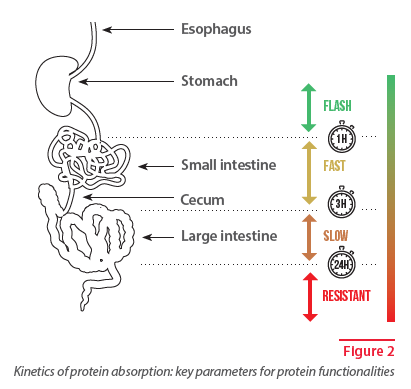
Protein digestibility of feed materials is an important factor for nutritionists, but it does not reflect the timing of absorption in the gut. The kinetics of protein absorption should be considered in addition to protein digestibility. It allows nutritionists to properly assess the quality of the protein source. Many properties and functionalities of proteins are related to their absorption kinetics. The kinetics of protein absorption helps categorize the protein fraction according to the speed of absorption. Four categories can be defined as flash, fast, slow and resistant along the digestive tract (Figure 2).

Did you know? Indigestible proteins are used as a substrate for undesirable bacteria in the gut, inducing proteolytic fermentation.
Ultimately, it may lead to diarrhoea due to microbiota dysbiosis (Jung Gao et al., 2019). Therefore, the higher the protein digestibility, the greater the protein source for animals from a digestive standpoint.
Kinetics of protein absorption: How is it measured?
Several in vitro methods simulating the digestive processes have been developed to estimate the protein digestibility and the kinetics of absorption.
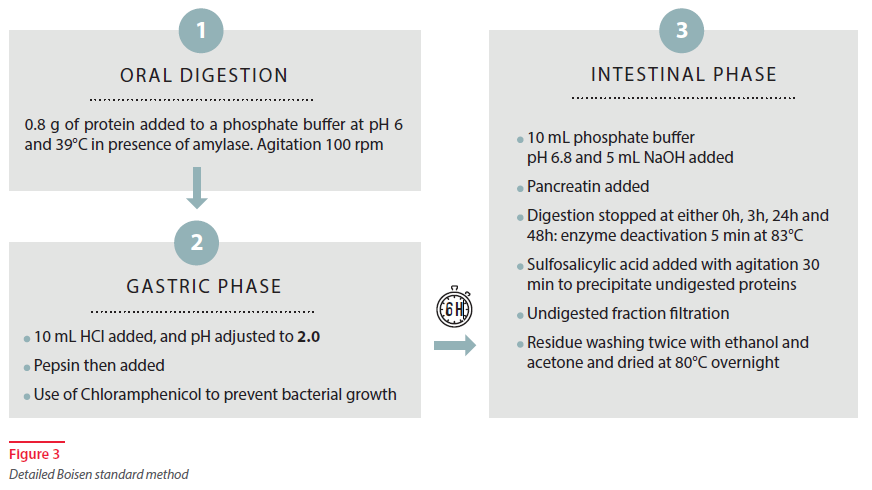
For example, the Boisen standard method (Boisen and Fernandez, 1995) is very accurate in measuring in vitro protein digestibility, which is calculated from the difference between nitrogen in the raw material sample and undigested residue measured at different time points of the intestinal pase (Figure 3).
Did you know? In most cases, validation of the methods is based on the relationship between in vitro results and values of apparent digestibility at the fecal or ileal level (Furuya et al., 1979; Metz and van der Meer, 1985; Graham et al., 1989; Cone and van der Poel, 1993). However, endogenous losses of proteins at the ileal level might have a great influence on in vivo digestibility while in vitro digestibility reflects the real digestibility of proteins and amino acids (Boisen and Eggum, 1991). Since in vitro digestibility does not take into account endogenous losses, the apparent ileal digestibility can only be predicted accurately from in vitro measurements, after correcting for the endogenous losses.
These losses may be influenced by a variety of factors, especially the fiber content in the diet (Taverner and Farrel, 1981; Wünsche et al., 1987). Alternatively, a considerable part of this variation may be explained by the amount of undigested dry matter at ileal level (Boisen, 1991).

By: Francesca Susca -Global Pet Product Manager- and Lisa Saibi -Product Manager Yeast derivatives & antioxidants
Source: Lallemand Animal Nutrition
You could be interested: The Gut-Skin Axis: A Postbiotic Strategy


Events

IBERZOO PROPET
11 to 13 March, 2026
Madrid, España
https://www.ifema.es/iberzoo-propet

Simposio CS Petfood & Aquafeed
15 to 16 April, 2026
Pilar, Buenos Aires, Argentina
https://www.cliviosolutions.com/

PET FOOD FORUM KANSAS
27 to 29 April, 2026
Kansas City, Missouri, USA
https://www.petfoodforumevents.com/

interpack
07 to 13 May, 2026
Düsseldorf, Alemania
https://www.interpack.com/

Smart Pet Food Production
11 May, 2026
Sheraton Carlton Nürnberg
https://www.petfoodcompetencenet.com/events/
Interzoo 2026
12 to 15 May, 2026
Nuremberg, Germany
https://www.interzoo.com/en

FENAGRA 2026
12 to 14 May, 2026
Santana – São Paulo
https://www.fenagra.com.br/

XXIV CONGRESO DE PET DE LA CBNA
12 to 14 May, 2026
São Paulo Expo, Brasil
https://www.fenagra.com.br/congresso/cbna-pet/

EXPO PACK México 2026
02 to 05 June, 2026
Ciudad de México, CDMX.
https://www.expopackmexico.com.mx/

VICTAM 2026
02 to 04 June, 2026
Utrecht, Países Bajos
https://victaminternational.com/

VIV Europe 2026
02 to 04 June, 2026
Utrecht, the Netherlands
https://www.viveurope.nl/

Foro Mascotas 2026
24 to 26 June, 2026
Expo Guadalajara, Mexico
https://www.foromascotas.mx/en

Pet South America 2026
12 to 14 August, 2026
São Paulo Expo, Brazil
https://petsa.com.br/

Pet Fair Asia 2026
19 to 23 August, 2026
Shanghai, China
https://en.petfairasia.com/

CIPAL 2026
23 to 24 September, 2026
Buenos Aires, Argentina
https://cipal.com.ar/?lang=en

PETZOO Eurasia
07 to 10 October, 2026
İFM- İstanbul Expo Center
https://petfuari.com/en/

SINPET 2026
15 to 16 October, 2026
Porto Alegre, Brazil
https://www.instagram.com/sinpet2026/

FIGAP 2026
21 to 23 October, 2026
Guadalajara, Jalisco, Mexico
https://figap.com/

Pet Fair South East Asia
28 to 30 October, 2026
Bangkok, Thailand
https://petfair-sea.com/
Advertising