4 min reading
By Armando Enriquez de la Fuente Blanquet
Wednesday, 13 of December, 2023Small actions also contribute to a circular economy
The origin of the circular economy dates to the 1970s when British economist David Pearce coined the term “zero waste economy.” Pearce proposed an economic model in which waste was eliminated through reuse, recycling, and composting. There is no exact date of its origin or a single precursor, although it has been applied in economic systems and industrial processes since the late 1970s.
The origin of the circular economy dates to the 1970s when British economist David Pearce coined the term “zero waste economy.” Pearce proposed an economic model in which waste was eliminated through reuse, recycling, and composting. There is no exact date of its origin or a single precursor, although it has been applied in economic systems and industrial processes since the late 1970s.
The circular economy is a production and consumption model that involves sharing, renting, reusing, repairing, renewing, and recycling existing materials and products for as long as possible. It aims to address global challenges such as climate change, biodiversity loss, waste management, and pollution. It is defined in contrast to the traditional linear economy.
It is a strategy that aims to reduce both the entry of virgin materials and waste production, closing resourcing economic and ecological flows. The analysis of physical resource flows comes from the industrial ecology school of thought, in which material flows are of two types: biological nutrients, designed to be reintroduced into the biosphere without technical incidents, and nutrients, which are designed to circulate with high quality in the production system but do not return to the biosphere.
Currently, in the pet food market, there is a wide variety of pet food seeking to meet nutritional needs. We see on the store shelves food for young, adult, old, sporting, sedentary, large, or small breed animals, and the like. This variety of foods supports a circular economy, as they provide a precise nutrient supply without excess. There is no waste of nutrients on the part of the pet.
Pet food production has different stages:
- Raw material selection.
- Feed formulation.
- Food Manufacturing.
- Handling of finished food.
Many of these production stages are already part of a circular economy. Let's reflect on the food formula. The objective of formulating a balanced pet food, or 'pet food,' is, first of all, to meet the nutritional requirements of dogs or cats. Nutrition is not in conflict with the circular economy, and it is possible to contribute through pet diets in different ways.
Pet food has been using by-products and secondary products from the food industry processing for a long time and is always looking for new windows of opportunity.
Let's talk, for example, about the sources of fatty acids, particularly omega-3. There are sources of both animal and plant origin, for instance, flaxseed is an excellent source of omega-3 (C:18:3), and this metabolite must be converted into DHA (C22:6) to meet the needs, but unfortunately, the dog or cat is inefficient in this process. Due to the above, it is common for pet food manufacturers to resort to other sources rich in omega 3-DHA to be added directly to the food, and the traditional sources are of marine origin, the so-called oily fish. This source of DHA can be a fish meal or fish extraction, but this requires large-scale ocean fishing and, therefore, makes it an unclean, inconsistent, and unsustainable source. It does not contribute as a circular economy resource. However, there are other sources of DHA based on seaweed as an alternative that are manufactured industrially without compromising the flora and fauna of the oceans and, in addition, are more consistent and sustainable. This source can contribute to a pet food strategy committed to the circular economy.

In my previous article, 'How do you design a feed formula', I talked about the importance of raw material selection in the design of a premix. This contains nutrients that are added in very small quantities to the total diet of the food, and speaking of raw materials of the premix, there are different sources of trace minerals. Some of them, due to their high bioavailability, become an alternative to contribute to the circular economy. For example, as seen in Table 1, organic, or hydroxy, sources of trace minerals have greater bioavailability of the nutrient in question, for example, zinc from a hydroxy-zinc source can be twice as bioavailable as a zinc oxide source (217.9%). That is to say, if we use a hydroxyzine source, a smaller amount of the raw material will be required to cover the zinc requirement than if a zinc oxide source were used.
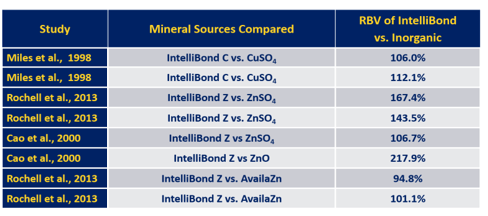
Table 1. RBV: Relative Bioavailability Value of a Hydroxy-mineral vs. an Inorganic or organic one.
On the other hand, a hydroxy source also has an environmental impact, as seen in Graph 1. An inorganic source of Cu produces a greater number of metals in salts soluble in aqueous media, which makes it a less environmentally friendly mineral source. Small contributions help pet food contribute to a circular economy. Although a trace mineral is at levels of parts per million (ppm) within the balanced feed, and at this level of inclusion, it would seem insignificant, in the end, it is adding to the efforts of a circular economy.
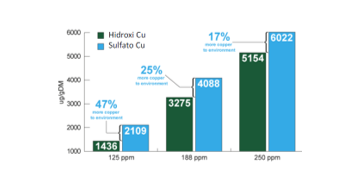
Graph 1. Leachable copper level with different copper sources
Finally, the production and management of balanced feed must have a plan of good manufacturing practices to minimize waste, operating costs, and capital investments.
The circular economy is a strategy for sustainability that seeks to reduce the consumption of natural resources and the production of waste, closing material flows. The circular economy has economic, social, and environmental benefits.

Source: All Pet Food Magazine
You could be interested: ANDRITZ: Technology to Feed the Future
About the author
Armando Enriquez de la Fuente BlanquetArmando Enríquez is from Mexico and, currently, works at Novus International as a Regional Country Manager, Mexico. Before, he worked at Trouw Nutrition Mexico as Feed Additives & Key Accounts Manager; he is also part of the company’s Global Companion Animal Community. He worked for DSM Nutritional Products in various positions: as a Marketing Manager in Pet Nutrition in Latin America, Vitamins Technical Manager in Latin America, Food Chain Project Manager and Commercial Manager in Mexico. He also worked at Roche Products as a Pets Project Manager, Ruminants Project Manager and Commercial Manager. He publishes editorials in specialized magazines in the Petfood industry and has lectured at the Andean Pet Forum in Colombia and at the Pet Forum, Mexico. He is a Veterinary Zootechnician from the National Autonomous University of Mexico and has a master's degree in Business Administration from the ITESO University.

Publisher Contents


Events

IBERZOO PROPET
11 to 13 March, 2026
Madrid, España
https://www.ifema.es/iberzoo-propet

Simposio CS Petfood & Aquafeed
15 to 16 April, 2026
Pilar, Buenos Aires, Argentina
https://www.cliviosolutions.com/

PET FOOD FORUM KANSAS
27 to 29 April, 2026
Kansas City, Missouri, USA
https://www.petfoodforumevents.com/

interpack
07 to 13 May, 2026
Düsseldorf, Alemania
https://www.interpack.com/

Smart Pet Food Production
11 May, 2026
Sheraton Carlton Nürnberg
https://www.petfoodcompetencenet.com/events/
Interzoo 2026
12 to 15 May, 2026
Nuremberg, Germany
https://www.interzoo.com/en

FENAGRA 2026
12 to 14 May, 2026
Santana – São Paulo
https://www.fenagra.com.br/

XXIV CONGRESO DE PET DE LA CBNA
12 to 14 May, 2026
São Paulo Expo, Brasil
https://www.fenagra.com.br/congresso/cbna-pet/

EXPO PACK México 2026
02 to 05 June, 2026
Ciudad de México, CDMX.
https://www.expopackmexico.com.mx/

VICTAM 2026
02 to 04 June, 2026
Utrecht, Países Bajos
https://victaminternational.com/

VIV Europe 2026
02 to 04 June, 2026
Utrecht, the Netherlands
https://www.viveurope.nl/

Foro Mascotas 2026
24 to 26 June, 2026
Expo Guadalajara, Mexico
https://www.foromascotas.mx/en

Pet South America 2026
12 to 14 August, 2026
São Paulo Expo, Brazil
https://petsa.com.br/

Pet Fair Asia 2026
19 to 23 August, 2026
Shanghai, China
https://en.petfairasia.com/

CIPAL 2026
23 to 24 September, 2026
Buenos Aires, Argentina
https://cipal.com.ar/?lang=en

PETZOO Eurasia
07 to 10 October, 2026
İFM- İstanbul Expo Center
https://petfuari.com/en/

SINPET 2026
15 to 16 October, 2026
Porto Alegre, Brazil
https://www.instagram.com/sinpet2026/

FIGAP 2026
21 to 23 October, 2026
Guadalajara, Jalisco, Mexico
https://figap.com/

Pet Fair South East Asia
28 to 30 October, 2026
Bangkok, Thailand
https://petfair-sea.com/
Advertising