5 min reading
Basic nutrition of our best friend, the dog: hydration in dogs
The Basic Nutrition of Our Best Friend, the Dog series have now arrived at their 5th article. In our last articles, we have talked about many important nutrition facts, from energy sources for your dogs to micronutrients and their importance.
The Basic Nutrition of Our Best Friend, the Dog series have now arrived at their 5th article. In our last articles, we have talked about many important nutrition facts, from energy sources for your dogs to micronutrients and their importance.
And now, in this next article, we will take a look at the topic of hydration in dogs, how important water is for pets' health, and what are the water requirements for dogs.
The importance of hydration
Hydration is important for all life. Water is a vital part of every single cell in the entire body, and just a small water loss can be critical to pets' health.
Did you know that dehydration predisposes pets to overheat (hyperthermia) and low blood pressure? If a pet experiences 1% body loss from dehydration, this can cause a 0.5 degrees increase in body temperature and a 2.5% reduction in blood plasma volume (1). These two factors combined increases the risk of heatstroke since the body temperature goes up and the reduced blood pressure leads to less blood to the extremities (ears, tongue, legs, etc.), where it could be cooled off.

Heatstroke is one of the most common causes of death in military working dogs (2,3), and dehydration was also the most common medical finding in dogs deployed to the 2010 earthquake in Haiti (4). For the search dogs working at the World Trade Center and Pentagon during the incident at 9/11 in 2001, dehydration was reported even though weather temperatures were moderate (5).
Thermoregulation strategy of the dog
Heat, humidity, and hydration, all affect a dog's ability to thermoregulate. Since outdoors heat and humidity can't be controlled by us, the work we humans can do to ensure optimal hydration of the dog becomes crucial.
Panting is the dogs' primary thermoregulation strategy; he or she inhales cooler, dryer air through the nose and mouth, which causes evaporative heat loss from the nose, mouth, and tongue, and the exhalation of hotter, moister air. If body heat generation is greater than the heat loss, and panting is not enough, the dog will increase salivation and lingual blood flow to try to cool down. Therefore, to be able to properly thermoregulate sufficient water intake is required.
Loss of water in dogs is a result of panting, urine and feces excretion, and some sweat loss through their paws. Depending on the type of workload and weather conditions, exercise can increase water losses by 10-20 times normal. Even mild dehydration can lead to decreased performance, decreased strength, and hyperthermia (6).
In hydrated dogs, the salivary loss is estimated to 7 mL/kg/h during exercise (7). To compensate for all this, the dog needs to replace the water loss by drinking water and eating food.
Basic nutrition of our best friend, the dog: important micronutrients

Water requirement in dogs
So, what are the daily water requirements of the general house dog? Several studies have provided different formulas for calculating the water need in dogs, and one thing is clear: the water requirement is closely connected to the food given, as well as the activity level and the temperature surrounding the dog.
An easy rule of thumb under normal activity levels and weather conditions may be as follows: when given dry food, the water requirement can be set to 1ml per 1 calory in the food. To exemplify this, a 20 kg dog eating 1250 kcal per day should get 1,25 liter water daily (8). Of this, approximately 0.25 liter will come from the food (water content in food + water from burning food to energy). The remaining water amount, 1 liter, the dog must drink each day.
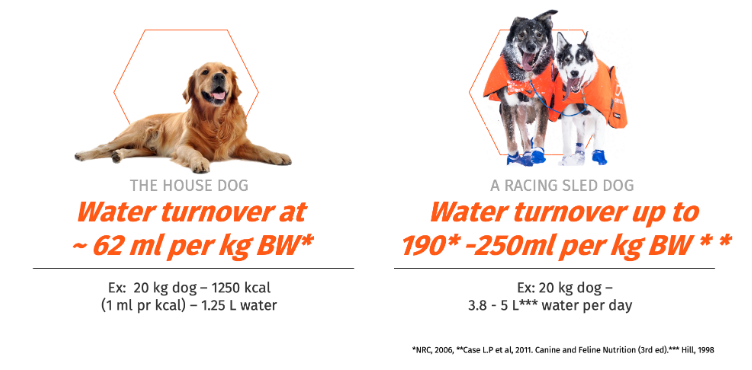
Studies have shown that dogs participating in 500km/300miles races could have a water turnover of up to 5 liters per day. For the general active dog or working dog, drinking water should be offered multiple times during the exercise to ensure appropriate hydration. If the dog does not consume enough, it should be blended into the food, to increase the daily water intake.
Electrolytes in active dogs
When talking about hydration, it is also worth mentioning electrolyte treatments. Electrolytes are various salts important for nerve impulses, muscle contractions, and fluid balance, amongst others. Electrolytes effectively bind the water in the body, and drinking water or sports drinks that contain electrolytes is a common strategy for humans to keep hydrated during activity.
However, humans have quite a different ability to sweat out excess salts compared to dogs. The human cooling strategy is based on 2-5 million sweat glands that can excrete water and salts in a large amount. For us, it can therefore be crucial to refill water and electrolytes during exercise. Dogs on the other hand have just a few sweat glands in their paws and only a very small salt loss from saliva while panting. Hence, the salt excretion through the dog's cooling strategy is almost absent. Therefore, common knowledge about electrolyte refill in human athletes cannot be applied to dogs.
Basic nutrition of our best friend, the dog: water and energy sources
Most studies of working or hunting dogs have shown only small or no electrolyte changes following exercise. For those who have tried electrolyte supplements on their dog during e.g. hunting season, salt poisoning has not been uncommon.
In a few studies of sled dogs, though, sodium was significantly decreased following 10 days of endurance racing. Therefore, only in extreme races, electrolytes may play an important role in the hydration of dogs. Ermon et al, 2014 (9) suggest up to 1.2g sodium per 1000kcal to prevent an exercise-induced drop in Na and K in sled dogs participating in the Iditarod race, but further studies are needed to confirm.

Conclusion
Dogs' water requirement depends on many factors: weather condition, air humidity, temperature, activity level, food intake, and body weight. Only a small body loss from dehydration can cause a significant drop in performance for your dog. To replace water, the dog must drink and eat sufficiently.
Therefore, be aware of these factors when exercising your dog. Calculate how much water your dog needs approx. per day and keep an eye on how much he or she drinks, as dehydration is not easily detected by the human eye in time. And finally, dogs' thermoregulation strategy is not like in humans, so stay clear of electrolyte supplements unless your dog is into extreme sports.
You could be interested: Creating a trusted and reputable brand in the pet food industry

Micro Ingredients


10/02/2026
Plasma: The Functional, Natural Miracle Ingredient for Dogs and Cats!

Events

IBERZOO PROPET
11 to 13 March, 2026
Madrid, España
https://www.ifema.es/iberzoo-propet

Simposio CS Petfood & Aquafeed
15 to 16 April, 2026
Pilar, Buenos Aires, Argentina
https://www.cliviosolutions.com/

PET FOOD FORUM KANSAS
27 to 29 April, 2026
Kansas City, Missouri, USA
https://www.petfoodforumevents.com/

interpack
07 to 13 May, 2026
Düsseldorf, Alemania
https://www.interpack.com/

Smart Pet Food Production
11 May, 2026
Sheraton Carlton Nürnberg
https://www.petfoodcompetencenet.com/events/

Interzoo 2026
12 to 15 May, 2026
Nuremberg, Germany
https://www.interzoo.com/en

FENAGRA 2026
12 to 14 May, 2026
Santana – São Paulo
https://www.fenagra.com.br/

XXIV CONGRESO DE PET DE LA CBNA
12 to 14 May, 2026
São Paulo Expo, Brasil
https://www.fenagra.com.br/congresso/cbna-pet/

EXPO PACK México 2026
02 to 05 June, 2026
Ciudad de México, CDMX.
https://www.expopackmexico.com.mx/

VICTAM 2026
02 to 04 June, 2026
Utrecht, Países Bajos
https://victaminternational.com/

VIV Europe 2026
02 to 04 June, 2026
Utrecht, the Netherlands
https://www.viveurope.nl/

Foro Mascotas 2026
24 to 26 June, 2026
Expo Guadalajara, Mexico
https://www.foromascotas.mx/en

Pet South America 2026
12 to 14 August, 2026
São Paulo Expo, Brazil
https://petsa.com.br/

Pet Fair Asia 2026
19 to 23 August, 2026
Shanghai, China
https://en.petfairasia.com/

CIPAL 2026
23 to 24 September, 2026
Buenos Aires, Argentina
https://cipal.com.ar/?lang=en

PETZOO Eurasia
07 to 10 October, 2026
İFM- İstanbul Expo Center
https://petfuari.com/en/

SINPET 2026
15 to 16 October, 2026
Porto Alegre, Brazil
https://www.instagram.com/sinpet2026/

FIGAP 2026
21 to 23 October, 2026
Guadalajara, Jalisco, Mexico
https://figap.com/

Pet Fair South East Asia
28 to 30 October, 2026
Bangkok, Thailand
https://petfair-sea.com/
Advertising