4 min reading
By Candela Bonaura
Wednesday, 14 of February, 2024Pet food definition, according to categories
In this era in which dogs and cats form part of the family as much as children, with such a strong trend, we must be responsible for meeting all their needs, including the quality of the food we offer them. Food is fundamental because pets eat every day and incorporate all the formula ingredients into their organism. But nowadays diet comes to fulfill more than just a nutritional function to cover the requirements.
In this era in which dogs and cats form part of the family as much as children, with such a strong trend, we must be responsible for meeting all their needs, including the quality of the food we offer them. Food is fundamental because pets eat every day and incorporate all the formula ingredients into their organism. But nowadays diet comes to fulfill more than just a nutritional function to cover the requirements.
Diet is a fundamental part of health, life quality, and slowing down physiological processes such as aging, prevention, and even treatment of multiple illnesses. And even though nowadays we have plenty of information on the nutritional requirements of pet animals, it is difficult to reach a consensus.
In this article, we discuss some concepts based on my analysis study and experience with my patients, considering that dogs and cats are carnivorous and, as such, require a greater supply of protein and ingredients of animal origin in most of their stages and states.
Food categories
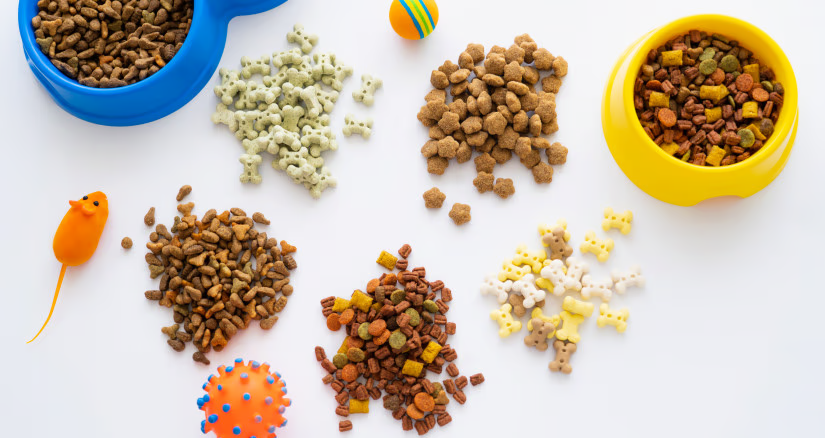
- Depending on their degree of processing: We will have ultra-processed foods (UP = dry or canned food or any other food intended for consumption by pets that is manufactured by carrying out a thermal or pressure processing step) or minimally processed (MP = fresh, frozen or any other food intended for consumption by pets, manufactured without thermal or pressure processing or one of them).
- By the % of water, we can divide them into dry (8-12% water), semi-humid (15-30% water), and humid (around 70% water).
- Depending on their function: complete foods (which cover a pet's whole nutritional needs) or supplements (for example, snacks or treats).
- Depending on its manufacturing type: they can be commercial or homemade foods (cooked, BARF, or raw).
- Depending on their age: Puppies (age will depend on animal size, up to 12-16-24 months) mainly focused on learning, immunity, development, and growth. Adults (from 12-16-24 months to 6-7 years of age), depending on animal size, whose main objective is balance and maintenance.Gerontes (+ 6-7), who seek a quality of life, promoting health by slowing down aging and the appearance of typical age-related diseases (kidney, heart, joint care, intestinal balance, nervous system health, etc.).
- Natural foods: They lack artificial colorings, flavors, and antioxidants while having a lower degree of processing. This represents a better life quality, greater digestibility, and use of certain nutrients.
- Functional foods: They include the so-called nutraceuticals or functional ingredients in their formula, which exert different functions or purposes in the body, such as joint protectors, immunomodulators, probiotics, antioxidants, anti-inflammatories, etc. These give the food added value beyond what is strictly nutritional.
- According to its quality: Ultra-premium, super-premium +, low super-premium or super-premium, premium, standard, or Economy. To enter a category, a food must meet most of its characteristics (beyond what a label says).
Ultra-premium or super-premium +

- Purchased at veterinarians or pet stores

- Foods with high-quality ingredients
- High nutritional density and greater digestibility
- Extensive portfolio that answers pet needs at different stages, sizes, and special requirements.
- With the greatest nutritional innovations on the market (functional ingredients +++)
- Size differential with kibble differential (in size and composition)
- Less fecal matter production
- Very digestible elements (a higher proportion of ingredients of animal origin and in the first orders)
- Greater benefits for the individual, such as shinier hair, more vitality, and better health
- Minimum digestibility of 80-90%
- Average protein and fat: 35-40/15-17, respectively
- Minimum animal protein of 70%
- Nutrient range with the highest industry standard
- Smaller portions needed
- No artificial colors, flavors, or preservatives
- High technology to take advantage of all ingredients' biological value
Super-premium - Found at veterinarians or pet stores
- High-quality ingredients
- High nutritional density and digestibility
- Extensive portfolio that answers pet needs at different stages, sizes, and special requirements
- Nutritional innovation (functional ingredients)
- Size differential with kibble differential (in size and composition)
- Less fecal matter production
- Greater benefits for the individual, such as shinier hair, more vitality, and better health
- Very digestible elements (large amounts of ingredients of animal origin)
- Minimum digestibility of 80%
- Average protein and fat of 30-40/14-16, respectively.
- Minimum animal protein of 60%
- High industry standard nutrient range
- Smaller portions needed
- No artificial colors or flavors
Premium - May contain artificial colors and flavors
- More fat and calories
- Made with animal or vegetable flour
- A mix of flavors, variety, and croquette shapes.
- Ingredients that protect joints, improve intestinal health and facilitate digestion
- Digestibility of 70-80%
- Average protein and fat of 24-34/10-15, respectively
- Animal protein is close to 40-50%
- Usually have an average price
Standard - mainstream - Low density (provided by proteins and fats)
- Low fat and protein content
- Digestibility less than 75%
- Target of consumers concerned about the price
- Protein source mixture of meat meal and other non-animal sources
- Low-quality ingredients
- Smaller portfolio (no size differentials, sometimes even stages, no special care products)
- Artificial colors, flavors, and preservatives
- Average protein and fat of 20-30/10-12, respectively

- Animal protein <40%
Economical - Low density (provided by proteins and fats)
- The lowest fat and protein content on the market
- Digestibility is less than 60%
- Target of consumers concerned about the price
- Protein source is a mixture of meat meal and bone powder
- Lower quality ingredients
- Smaller portfolio (no size differentials, sometimes even stages, no special care products)
- Artificial colors, flavors, and preservatives
- Average protein and fat of 20-27/8-10, respectively
- Animal protein <30%
- Poorly digestible fibers
9. Therapeutic: These are foods intended for a specific stage of an animal or need. They can be temporary or permanent, aimed at preventing, helping, or treating a specific disease. They are another clinical tool, a therapeutic one, sometimes the main one of a treatment (DIETOTHERAPY).
Although there is no specific legislation, we must consider the digestibility, type of meat or meat flour, differential of kibbles or sizes, portfolio, colorant presence, antioxidants, or palatability as important aspects when selecting the appropriate product for a pet's needs.
Product price, in general, is determined by the ingredients used (which are or should be organized in descending order), energy density, protein quantity and quality, and nutraceutical addition.
We must be able to guarantee complete food that covers the requirements of an animal according to their needs, stage and size, digestibility (maximum nutrient use), good energy intake (3000-5000 Kcal), palatability, and safety.
By: Dr. Bonaura M. Candela.
Source: All Pet Food Magazine.
You could be interested: From Claim to Credibility: The Case for Research-Backed Pet Food Ingredients

About the author
Candela BonauraCandela is a Veterinary Medical Doctor, ex CONICET researcher, Research Analyst and Scientific Communication, and FCV-UNLP Professor in different subjects, such as General Pathology, Small Animal Clinic, Electron Microscopy Service, Pig Production, and Animal Reproduction. She conducted numerous individual and group research projects on distinct species, such as cattle, horses, pigs, marine fauna, and felines. Speaker in graduate and postgraduate courses in Nutrition and small animals' reproduction, teaching courses, and personalized advice to veterinary clinics. Online service and on-site events coordination.


Publisher Contents

Events

IBERZOO PROPET
11 to 13 March, 2026
Madrid, España
https://www.ifema.es/iberzoo-propet

Simposio CS Petfood & Aquafeed
15 to 16 April, 2026
Pilar, Buenos Aires, Argentina
https://www.cliviosolutions.com/

PET FOOD FORUM KANSAS
27 to 29 April, 2026
Kansas City, Missouri, USA
https://www.petfoodforumevents.com/

interpack
07 to 13 May, 2026
Düsseldorf, Alemania
https://www.interpack.com/

Smart Pet Food Production
11 May, 2026
Sheraton Carlton Nürnberg
https://www.petfoodcompetencenet.com/events/
Interzoo 2026
12 to 15 May, 2026
Nuremberg, Germany
https://www.interzoo.com/en

FENAGRA 2026
12 to 14 May, 2026
Santana – São Paulo
https://www.fenagra.com.br/

XXIV CONGRESO DE PET DE LA CBNA
12 to 14 May, 2026
São Paulo Expo, Brasil
https://www.fenagra.com.br/congresso/cbna-pet/

EXPO PACK México 2026
02 to 05 June, 2026
Ciudad de México, CDMX.
https://www.expopackmexico.com.mx/

VICTAM 2026
02 to 04 June, 2026
Utrecht, Países Bajos
https://victaminternational.com/

VIV Europe 2026
02 to 04 June, 2026
Utrecht, the Netherlands
https://www.viveurope.nl/

Foro Mascotas 2026
24 to 26 June, 2026
Expo Guadalajara, Mexico
https://www.foromascotas.mx/en

Pet South America 2026
12 to 14 August, 2026
São Paulo Expo, Brazil
https://petsa.com.br/

Pet Fair Asia 2026
19 to 23 August, 2026
Shanghai, China
https://en.petfairasia.com/

CIPAL 2026
23 to 24 September, 2026
Buenos Aires, Argentina
https://cipal.com.ar/?lang=en

PETZOO Eurasia
07 to 10 October, 2026
İFM- İstanbul Expo Center
https://petfuari.com/en/

SINPET 2026
15 to 16 October, 2026
Porto Alegre, Brazil
https://www.instagram.com/sinpet2026/

FIGAP 2026
21 to 23 October, 2026
Guadalajara, Jalisco, Mexico
https://figap.com/

Pet Fair South East Asia
28 to 30 October, 2026
Bangkok, Thailand
https://petfair-sea.com/
Advertising