5 min reading
Plant-based proteins for more sustainable pet food
With the tremendous growth of the pet food industry and its impact on the environment, there is an increasing need for an alternative for meat ingredients. Plant-based proteins which is becoming more and more popular in pet food, might just be the perfect solution.
With the tremendous growth of the pet food industry and its impact on the environment, there is an increasing need for an alternative for meat ingredients. Plant-based proteins which is becoming more and more popular in pet food, might just be the perfect solution.

According to the latest data, the number of dogs and cats in the world is around 471 and 370 million respectively, however, this population is constantly increasing, especially due to Covid-19 when many people decided to adopt a pet for company. This has resulted in a huge increase of pet food production, with annual worldwide sales currently at 102.6 bn USD. This in turn, also has consequential impacts on the planet.
Environmental impact
What is the global environmental impact of the pet food industry? To produce dry food for our dogs and cats, around 41-48 million hectares of land (an area twice the size of the UK) is used annually. This is linked to 56–151 million tons of CO2 emissions annually, which represents 1,1% − 2,9% of global agricultural emissions.
{{editor}}
The main cause of this problem is due to the high amount of meat included in pet food. To produce meat, land is needed for both livestock breeding and for the crops to produce their feed.
Moreover, a consistent component of commercial pet food are animal by-products (ABPs). To be in line with the latest human trends, the usage of ABPs will most likely be reduced in the coming years. The decrease of ABPs in pet food would be also important for sustainability reasons. In fact, contrary to the common belief that ABPs are zero-impact ingredients, their use provides a financial return to livestock industry that incentives increased animal production, with negative consequences on the environment.
Therefore, to reduce the impacts of ABPs, meat industry can find some alternative and maybe more sustainable uses of them, such as in fertiliser and as biofuel, creating a new balance in the market.
Switching to plant-based products
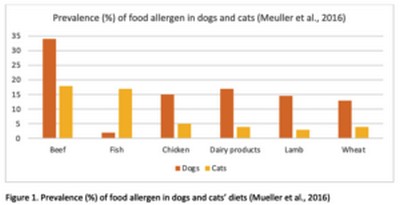
Data shows the need to minimise the use of animal proteins and the need to replace these products with more efficient plant-based products which are sustainably grown and harvested. This is not only better for the planet, but also for our pets. According to the review research of Mueller et al. (2016), the most common food allergens causing negative cutaneous reactions in dogs (see figure 1) are beef (34%), dairy products (17%), chicken (15%), lamb (14,5%) and wheat (13%). A similar situation (also figure 1) can be found in cats, where the main food allergens were reported to be beef (18%), fish (17%), chicken (5%), wheat and dairy products (4%) and lamb (3%).
To conclude, partly replacing meat and fish products with plant-based ingredients will most likely also help to reduce food-derived allergic reactions in pets.
Organic and vegan
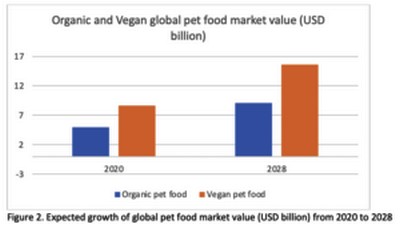
Taking this all into account, it is not a surprise that we are seeing a huge increase of pet food trends such as; natural, organic, sustainable, vegetarian and vegan. In fact, recent market research (see figure 2) shows that the global organic petfood market value is expected to grow from 4,9 billion USD in 2020 to 9,1 billion USD in 2028. The global vegan pet food market value is expected to grow from 9,6 billion USD in 2020 to 15,6 billion USD by 2028.
In the future we also expect more human food trends to influence the pet food market. For example, one currently emerging human trend that could potentially become popular for pets is the flexitarian (or flexible vegetarian) diet. This means reducing, without eliminating, the consumption of meat and animal protein in favour of plant-based proteins. All these trends are starting to increase the demand for alternative, non-animal protein ingredients in pet food.
Innovative plant-based proteins
Due to the popularity of plant-based ingredients, the percentage of plant-based proteins in pet food formulations has increased. The most used products are traditional ingredients such as; corn gluten meal, vital wheat gluten and soy protein, as well as other options like rice, pea, potato and sunflower. More recently, innovative ingredients like single cell protein and Lemna protein, have started to make an appearance in pet food formulations.
Various solutions
Since there are several plant-based ingredients currently available on the market, it is important to choose the right product for each application. Below are listed some possible plant-based solutions with their recommended usage in pet food formulations.
Rice protein
Rice protein is a great ingredient for both wet and dry pet food which is particularly beneficial for hypoallergenic diets and in formulations for puppies and kittens. It is highly digestible, has a balanced amino acids profile and is a source of energy.
Pea protein
When it comes to grain free, gluten free and hypoallergenic diets, a perfect solution is pea protein. Thanks to its high digestibility and palatability, pea can be used in all kinds of formulations. It also acts a stabilizer, improving the consistency of pet food. Another great solution for hypoallergenic and grain/gluten free diets, is potato protein, characterized by a highly digestible and balanced amino acid profile.

Sunflower protein
Last but not least, another sustainable and natural protein source is sunflower protein. This protein source can be used in both dry and wet pet food, also acting as a colouring agent. It can be a great solution for grain/gluten free and hypoallergenic diets, it is highly digestible and has a neutral taste that does not create palatability issues.
Single cell proteins and Lemna protein
In addition to sustainable ingredients, more innovative products have started to appear in the pet food ingredient market, such as single cell proteins or Lemna protein.
Single cell proteins are the dried microbial cell or total protein extracted from pure microbial cell culture (algae, bacteria, filamentous fungi, yeast). Due to its origin, it can be successfully used in all kinds of pet food diets, i.e. hypoallergenic, grain free, natural, etc.
Water lentils or Lemna protein is highly digestible and palatable, with a high level of antioxidants and minerals, like calcium and phosphorous. Thanks to its omega 3 content, it is also a good solution to improve immunity and skin and coat conditions.
Yeast-based protein
Yeast products can also be used as sustainable alternative protein sources for animal products. Beside the more traditional brewer's yeast, pet food diets can also be supplemented with other yeast-based products like yeast extract, hydrolysed yeast or autolysed yeast. The benefits of these products are mainly related to the high palatability and digestibility, plus their good content of MOS, β-glucans and nucleotides for a better immunity.
As a leading global life science ingredients distributor, Barentz Animal Nutrition can supply all the above-mentioned plant-based proteins and help pet food manufacturers find the right products for their formulations.
By barenz
Source: PetFood Pro
For more information visit https://www.barentz.com/animal-nutrition/pet-food/
You could be interested: Tailored Fiber Solutions: How Functional Fibers Fit Your Process Needs



Events

IBERZOO PROPET
11 to 13 March, 2026
Madrid, España
https://www.ifema.es/iberzoo-propet

Simposio CS Petfood & Aquafeed
15 to 16 April, 2026
Pilar, Buenos Aires, Argentina
https://www.cliviosolutions.com/

PET FOOD FORUM KANSAS
27 to 29 April, 2026
Kansas City, Missouri, USA
https://www.petfoodforumevents.com/

interpack
07 to 13 May, 2026
Düsseldorf, Alemania
https://www.interpack.com/

Smart Pet Food Production
11 May, 2026
Sheraton Carlton Nürnberg
https://www.petfoodcompetencenet.com/events/
Interzoo 2026
12 to 15 May, 2026
Nuremberg, Germany
https://www.interzoo.com/en

FENAGRA 2026
12 to 14 May, 2026
Santana – São Paulo
https://www.fenagra.com.br/

XXIV CONGRESO DE PET DE LA CBNA
12 to 14 May, 2026
São Paulo Expo, Brasil
https://www.fenagra.com.br/congresso/cbna-pet/

EXPO PACK México 2026
02 to 05 June, 2026
Ciudad de México, CDMX.
https://www.expopackmexico.com.mx/

VICTAM 2026
02 to 04 June, 2026
Utrecht, Países Bajos
https://victaminternational.com/

VIV Europe 2026
02 to 04 June, 2026
Utrecht, the Netherlands
https://www.viveurope.nl/

Foro Mascotas 2026
24 to 26 June, 2026
Expo Guadalajara, Mexico
https://www.foromascotas.mx/en

Pet South America 2026
12 to 14 August, 2026
São Paulo Expo, Brazil
https://petsa.com.br/

Pet Fair Asia 2026
19 to 23 August, 2026
Shanghai, China
https://en.petfairasia.com/

CIPAL 2026
23 to 24 September, 2026
Buenos Aires, Argentina
https://cipal.com.ar/?lang=en

PETZOO Eurasia
07 to 10 October, 2026
İFM- İstanbul Expo Center
https://petfuari.com/en/

SINPET 2026
15 to 16 October, 2026
Porto Alegre, Brazil
https://www.instagram.com/sinpet2026/

FIGAP 2026
21 to 23 October, 2026
Guadalajara, Jalisco, Mexico
https://figap.com/

Pet Fair South East Asia
28 to 30 October, 2026
Bangkok, Thailand
https://petfair-sea.com/
Advertising