4 min reading
The South African farm turning Flies into Food for Pets - and Maybe People
There is a burgeoning demand for insects as a source of protein in pet food. Photographer Tommy Trenchard visited a fly farm in Cape Town, South Africa, that is hoping to benefit.
There is a burgeoning demand for insects as a source of protein in pet food. Photographer Tommy Trenchard visited a fly farm in Cape Town, South Africa, that is hoping to benefit.
Launched in 2018 on an industrial estate on the edge of the city, the Maltento farm feels a long way from its more conventional rural equivalent. Yet each month it pumps out over 10 tonnes of high quality protein-rich feed, most of it destined for export overseas.
"You've got a food shortage, and people who are starving, and then you've got a waste problem at the same time. So I started looking at how we can rebalance that," said founder Dean Smorenberg, reflecting on what inspired him to get into this field. He is a former management consultant who began farming black soldier flies in his bathroom in 2016 before entering the business full-time.
The model is an appealing one to carbon-conscious consumers: the fly larvae feed on waste food products - in this case mainly spent grains from a nearby brewery - turning it into marketable protein and producing a fertiliser by-product. The process consumes significantly less water and land than other types of protein production and is far less carbon intensive.
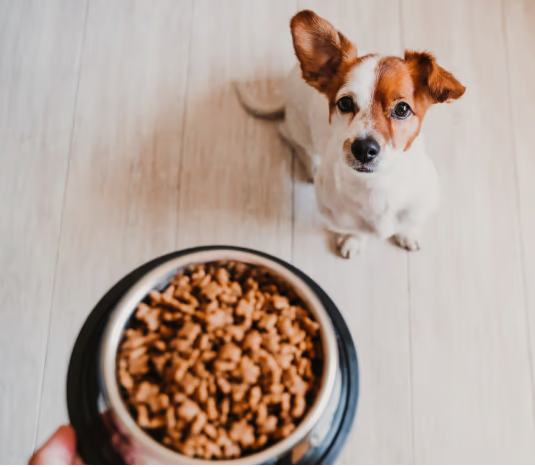
A 2020 study by researchers in the UK and Germany found that the global pet-food market releases as much carbon dioxide into the atmosphere as the total emissions of the Philippines or Mozambique.
Rather than looking to directly challenge the massive global soy or fishmeal industries, which currently provide much of the world's affordable protein, Maltento is looking to offer products that supplement a pet food's flavour or nutritional properties. "Insects have a lot more value than just being a protein," says Mr Smorenberg, pointing out that what are known as antimicrobial peptides in the fly larvae help to improve gut health.
"And there's no other crop in the world that can give you 52 harvests a year from one space." The Maltento farm, which is expanding rapidly, is divided into sections according to the various stages of the insects' lifecycle. Pupae undergo metamorphosis in a dark room on the ground floor before being moved upstairs to a breeding enclosure, where adult flies under ultraviolet lights lay eggs in mesh cages.
"This is basically the engine room of the farm, if you like," says Dominic Malan, who is responsible for growing the number of potential customers. "The temperature and the humidity are the most important things to make sure they thrive."
Next door, in the nursery, the eggs hatch into "neonates" which are distributed into small plastic containers full of feed. These are then stacked in temperature-controlled chambers where they grow at an extraordinary rate. "We put in 0.5g of these little guys," says Mr Malan. "And after six days they've grown [collectively] to 4kg. They're such voracious feeders."
Once the flies are fully grown, the containers are emptied into a machine that separates them from the "frass" - effectively fly manure - which will be sold as a kind of organic fertiliser. Mr Malan says there has been considerable interest in this by-product from the pharmaceutical cannabis sector.

From this point the flies' larvae can go one of several ways.
Many are dried out and exported whole to feed pet chickens in the US. Others are effectively minced into a rough powder which will be used by a Norwegian firm to make dog food. Others still are pressed for their oils, or hydrolysed into a liquid digest. In the corner of the room lie rows of giant white sacks full to the brim with dried larvae.
To a human, the bugs taste earthy, with a subtle maltiness that comes from the spent grains on which they are fed. To cats and dogs, says Mr Malan, they are irresistible. According to RaboResearch, a Dutch agribusiness research organisation, global production of insect protein for pet food could reach half a million tonnes by the end of the decade, up from barely 10,000 tonnes today. And it is an industry that is evolving fast.
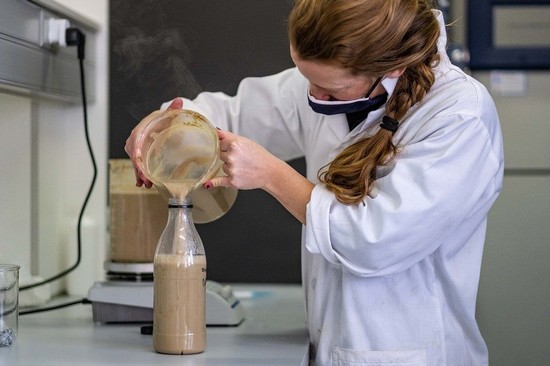
At a laboratory in the Woodstock neighbourhood of the city, with views of Table Mountain, the farm's scientists are constantly seeking to improve the taste and health benefits of the larvae products.
This depends on the diet the larvae are fed, the conditions in which they are grown, and also how the final product is processed. "They're actually really versatile," says Dr Leah Bessa, a food scientist with a PhD in using fly larvae as a meat substitute for human consumption.
"There's a lot of functionality yet to be unlocked."
The latest product Dr Bessa has been working on is something designed to be added to pet foods to improve their taste and nutritional benefits. Before joining Maltento, she made headlines in South Africa after launching a company that sold insect-based ice cream.
In a 2013 report, the UN's Food and Agriculture Organisation said eating insects could help to address food shortages around the world. But despite insects being a popular snack in many countries, Western nations have proved resistant. For now, Dr Bessa believes large-scale insect consumption is likely to remain mostly confined to pets.
"We're just not quite there yet," she says, adding that squeamishness remains an obstacle. "Dogs are a lot easier to feed insects to than humans at this point."
All photographs by Tommy Trenchard
You could be interested: Innovative FEED Act introduced in US House of Representatives

Animal Origin

23/10/2023
Tyson Foods Announces Partnership with Protix for More Sustainable Protein Production

Events

IBERZOO PROPET
11 to 13 March, 2026
Madrid, España
https://www.ifema.es/iberzoo-propet

Simposio CS Petfood & Aquafeed
15 to 16 April, 2026
Pilar, Buenos Aires, Argentina
https://www.cliviosolutions.com/

PET FOOD FORUM KANSAS
27 to 29 April, 2026
Kansas City, Missouri, USA
https://www.petfoodforumevents.com/

interpack
07 to 13 May, 2026
Düsseldorf, Alemania
https://www.interpack.com/

Smart Pet Food Production
11 May, 2026
Sheraton Carlton Nürnberg
https://www.petfoodcompetencenet.com/events/

Interzoo 2026
12 to 15 May, 2026
Nuremberg, Germany
https://www.interzoo.com/en

FENAGRA 2026
12 to 14 May, 2026
Santana – São Paulo
https://www.fenagra.com.br/

XXIV CONGRESO DE PET DE LA CBNA
12 to 14 May, 2026
São Paulo Expo, Brasil
https://www.fenagra.com.br/congresso/cbna-pet/

EXPO PACK México 2026
02 to 05 June, 2026
Ciudad de México, CDMX.
https://www.expopackmexico.com.mx/

VICTAM 2026
02 to 04 June, 2026
Utrecht, Países Bajos
https://victaminternational.com/

VIV Europe 2026
02 to 04 June, 2026
Utrecht, the Netherlands
https://www.viveurope.nl/

Foro Mascotas 2026
24 to 26 June, 2026
Expo Guadalajara, Mexico
https://www.foromascotas.mx/en

Pet South America 2026
12 to 14 August, 2026
São Paulo Expo, Brazil
https://petsa.com.br/

Pet Fair Asia 2026
19 to 23 August, 2026
Shanghai, China
https://en.petfairasia.com/

CIPAL 2026
23 to 24 September, 2026
Buenos Aires, Argentina
https://cipal.com.ar/?lang=en

PETZOO Eurasia
07 to 10 October, 2026
İFM- İstanbul Expo Center
https://petfuari.com/en/

SINPET 2026
15 to 16 October, 2026
Porto Alegre, Brazil
https://www.instagram.com/sinpet2026/

FIGAP 2026
21 to 23 October, 2026
Guadalajara, Jalisco, Mexico
https://figap.com/

Pet Fair South East Asia
28 to 30 October, 2026
Bangkok, Thailand
https://petfair-sea.com/
Advertising