3 min reading
Beyond Consumpyion - Measuring Cat's Food Enjoyment - Research and development AFB Intenational
Typical cat food palatability assessments consist of either:
Preference trials: A two-bowl trial measuring consumption when given two options. The first bowl approached, first food tasted, amount consumed, and intake ratio are used to measure preference.
Acceptance trials: A one-bowl trial that generally only measures the amount consumed.
While these common trial methods are valuable in assessing preference and palatability, AFB International sought to determine other ways to evaluate cat food enjoyment, as well as develop methods that would be representative of what pet parents might experience at home.
Trials conducted at AFB's Palatability Assessment Resource Center (PARC) found behavior methods can augment consumption data in preference and acceptance trials to provide additional insight to a cat's feeding experience.
FOOD FOCUS - Nose in BowlSM (NIB) Trial

Purpose: Measure cat's interest in food and help distinguish products with similar consumption
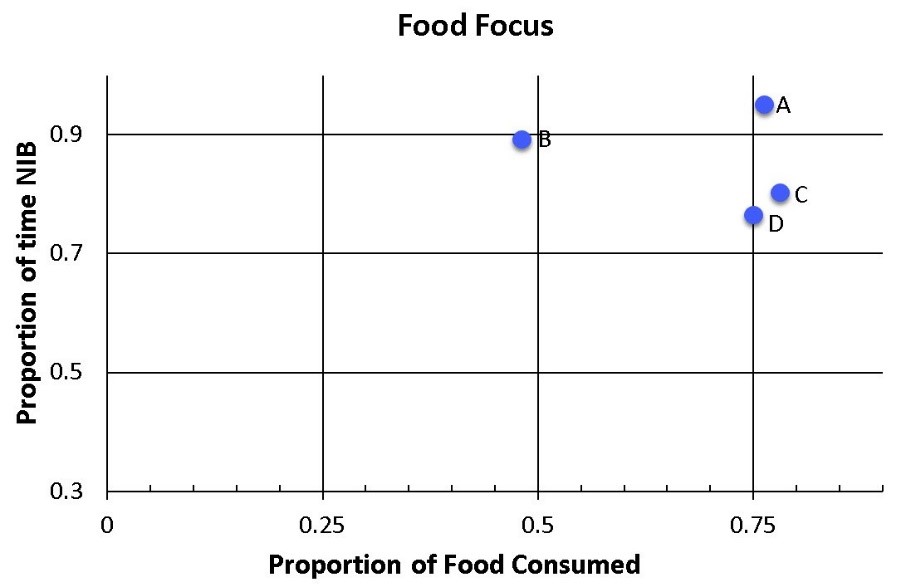
Approach: Sixteen individual cats were fed four diets over four days in acceptance trials. Video- recordings aided in using food focus to distinguish preference between diets. Food focus, defined as the time spent eating, sniffing, and engaged with their food, was quantified versus time distracted. High food focus indicated palatable food and high enjoyment. Low food focus indicated the cat was distracted while eating, which could be related to palatability.
Results: As shown in Chart 1, three diets had similar consumption, but diet A had significantly higher food focus. This indicates diet A was enjoyed more than C or D. And while diet B also had high focus, the proportion of food consumed was much less than the other diets. This could indicate the cat had difficulty biting or chewing the food, and may provide insight to pet food manufacturers on where to focus product improvements.
WORK EFFORT - Puzzle Trials
Purpose: Measure effort cats are willing to exert for treats, as well as mimic the effort cats are expected to 'perform' for treats at home.
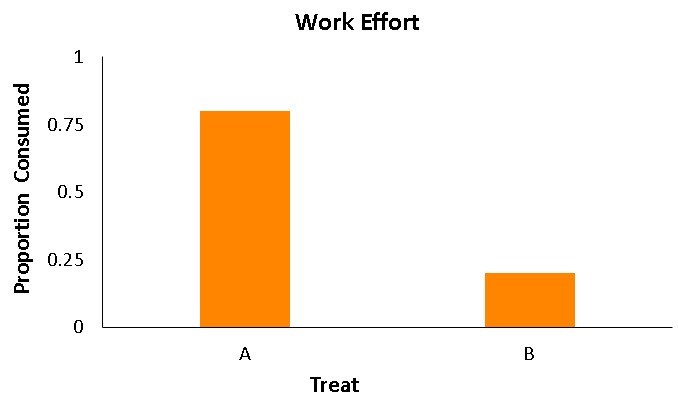
Approach: Puzzles presented obstacles between the cat and treats. Sixteen individual cats were offered two puzzles, each with a different commercialized cat treat dispersed throughout. As the cat consumed treats from one puzzle (Treat A), it became more difficult to find and reach the remainder of Treat A, but easier to find and reach Treat B in the other puzzle. The trial completed when each cat consumed 50% of total treats offered. Treats consumed (Treat A vs. Treat B) were quantified and indicated preference.
Marketplace


Results: This measure aids in distinguishing differences between cat treats. Chart 2 illustrates that despite the cats needing to exert less effort to obtain Treat B, the cats persisted in choosing Treat A - the more palatable option.
INTERACTION - Hand-Feeding Trials
Purpose: Evaluate a food's ability to entice cats into the lap of their pet parent and prolong interaction after the food is gone.
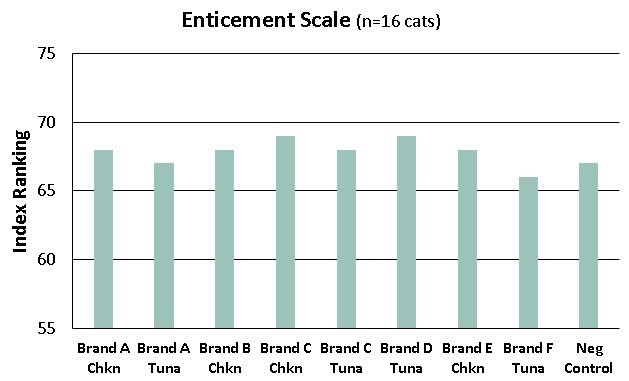
Approach: Sixteen individual cats were offered, by hand, commercialized paste treats encouraging close contact during feeding. Development of enticement and interaction scales intends to interpret treat preference and enjoyment in future trials.
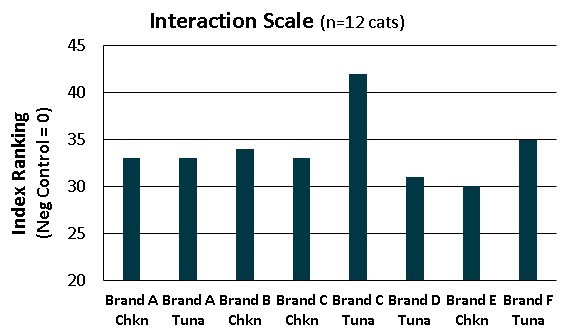
Preliminary Results: All treats enticed most cats to the greatest behavior measure – sitting in a technician's lap (Chart 3). The interaction scale (Chart 4) suggested the more a cat enjoyed the treat, the longer he allowed interaction (petting), even when no more food was offered. Brand C Tuna influenced cats to interact the longest, suggesting the interaction scale can differentiate products.
Conclusions
Behavior trials with kibble, dry treats and paste treats demonstrated additional ways to assess palatability and food enjoyment beyond consumption to describe an additional dimension of the cat's feeding experience.
Behavior and enjoyment data can augment consumption data to help pet food manufacturers develop products that provide more interaction between pet parents and their cats, and the assurance they are offering their cat a food they enjoy, not just eat.
To learn more about Applied Behavior Research, contact Susan Jojola.
By: AFB Intenational
You could be interested: AFB International Appoints Mark Vossenaar as General Manager, Europe


About the company

About the company
WHAT WE DO
At AFB International, we develop and produce a full range of liquid and dry palatability enhancers. We use high-quality ingredients proven to optimize companion animal response and consumption.
Our specialty? Meeting your unique needs with custom support. Our worldwide staff of technical experts is ready to assist you with all aspects of palatability enhancement, from product development and testing to processing, logistics and more.
HOW WE WORK
Our successful customer relationships are built on clear, consistent communication—starting with really listening to understand your needs so we can respond quickly and effectively. And we keep listening. AFB scientists and technical service managers routinely travel to customer facilities to clearly understand the challenges at hand and the systems in place. Then we can recommend the best viable solutions.
OUR TEAM
AFB is dedicated to improving the health and wellness of companion animals worldwide through superior products and services. Our diverse, committed team works collaboratively to serve our clients. Get to know us—and let us know how we can help you!
HISTORY
AFB launched in 1986 and has grown to be the global science and technology leader in pet food palatability. Headquartered in St. Charles, Missouri, USA, AFB is a global company with state-of-the-art facilities in the United States, Argentina, Brazil, Mexico, the Netherlands, China, and Australia. AFB is a wholly owned subsidiary of Ensign-Bickford Industries, Inc., a privately held, family-owned, professionally managed technical business that traces its roots back more than 185 years.



Videos

Events

IBERZOO PROPET
11 to 13 March, 2026
Madrid, España
https://www.ifema.es/iberzoo-propet

Simposio CS Petfood & Aquafeed
15 to 16 April, 2026
Pilar, Buenos Aires, Argentina
https://www.cliviosolutions.com/

PET FOOD FORUM KANSAS
27 to 29 April, 2026
Kansas City, Missouri, USA
https://www.petfoodforumevents.com/

interpack
07 to 13 May, 2026
Düsseldorf, Alemania
https://www.interpack.com/

Smart Pet Food Production
11 May, 2026
Sheraton Carlton Nürnberg
https://www.petfoodcompetencenet.com/events/
Interzoo 2026
12 to 15 May, 2026
Nuremberg, Germany
https://www.interzoo.com/en

FENAGRA 2026
12 to 14 May, 2026
Santana – São Paulo
https://www.fenagra.com.br/

XXIV CONGRESO DE PET DE LA CBNA
12 to 14 May, 2026
São Paulo Expo, Brasil
https://www.fenagra.com.br/congresso/cbna-pet/

EXPO PACK México 2026
02 to 05 June, 2026
Ciudad de México, CDMX.
https://www.expopackmexico.com.mx/

VICTAM 2026
02 to 04 June, 2026
Utrecht, Países Bajos
https://victaminternational.com/

VIV Europe 2026
02 to 04 June, 2026
Utrecht, the Netherlands
https://www.viveurope.nl/

Foro Mascotas 2026
24 to 26 June, 2026
Expo Guadalajara, Mexico
https://www.foromascotas.mx/en

Pet South America 2026
12 to 14 August, 2026
São Paulo Expo, Brazil
https://petsa.com.br/

Pet Fair Asia 2026
19 to 23 August, 2026
Shanghai, China
https://en.petfairasia.com/

CIPAL 2026
23 to 24 September, 2026
Buenos Aires, Argentina
https://cipal.com.ar/?lang=en

PETZOO Eurasia
07 to 10 October, 2026
İFM- İstanbul Expo Center
https://petfuari.com/en/

SINPET 2026
15 to 16 October, 2026
Porto Alegre, Brazil
https://www.instagram.com/sinpet2026/

FIGAP 2026
21 to 23 October, 2026
Guadalajara, Jalisco, Mexico
https://figap.com/

Pet Fair South East Asia
28 to 30 October, 2026
Bangkok, Thailand
https://petfair-sea.com/
Advertising