16/02/2024
Wet Pet Food Quality
Wet pet food is a popular choice among pet owners, with more than 6.5 billion kgs sold in 2022¹. Pet owners often see wet pet food as a more premium option than traditional dry kibble diets.
They expect their preferred wet pet food brand to be palatable to their pets and have the same appealing aroma, color, and texture every time they open a can or pouch. Consistency in these qualities is particularly important for pet food manufacturers to maintain their brand image. Flavor, aroma, color, and texture can be affected by key parameters of pet food production, including processing conditions, pH, grind size, and thickeners.
Kemin: Your partner in wet pet food
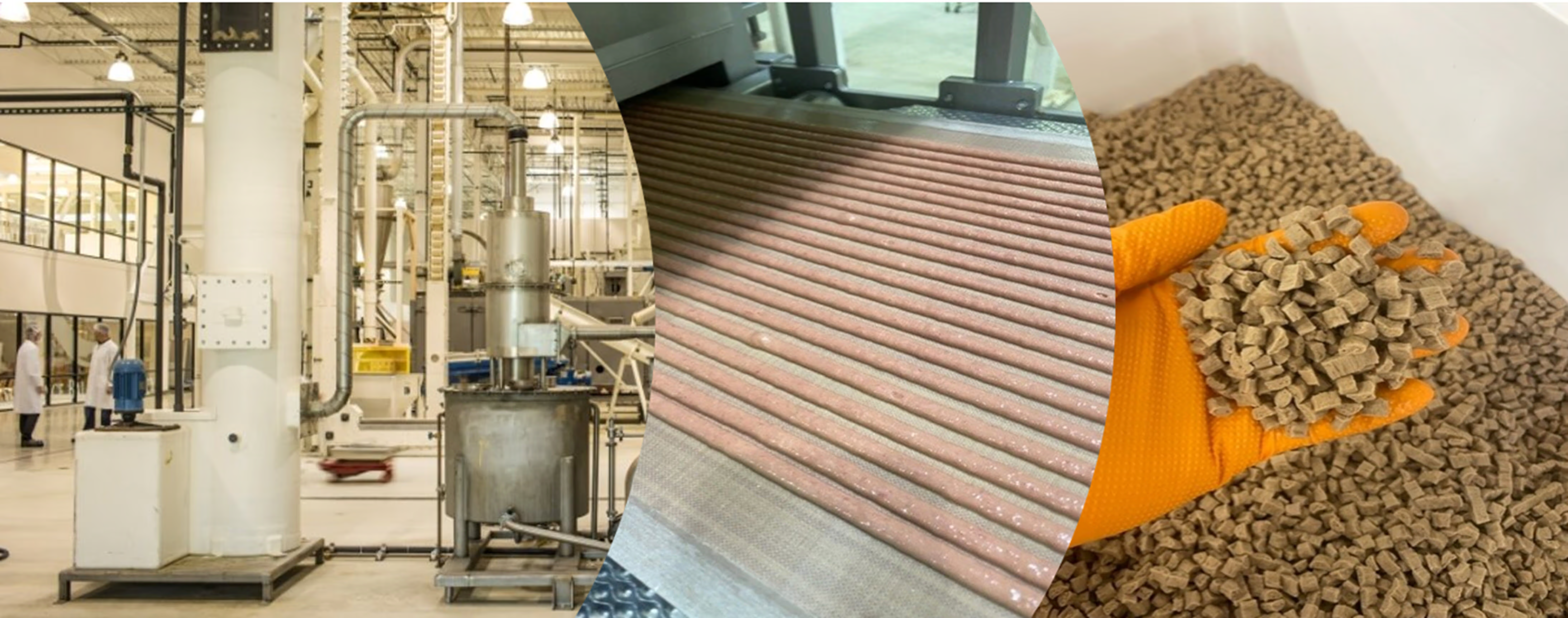
Testing solutions in wet pet food is more complex than in dry foods. Kemin has invested in a wet pet food pilot facility to provide partnership opportunities with customers seeking solutions to their wet pet food challenges.
This facility is used to build pilot-scale wet pet food batches of loaf or chunk in gravy formulas in cans, trays, and pouches. This facility offers an opportunity to leverage Kemin's expertise across the value chain to help address several key challenges, including palatability, biogenic amine formation, and color retention.
At Kemin, we care that our solutions work in pet food matrices and have minimal impact to product integrity and quality standards. Therefore, pilot-scale wet pet food runs can be tested for many success criteria, including palatability, texture, viscosity, pH, color, weep, and aroma analysis, depending on customer needs.
The right texture
While each wet pet meat dough manufacturing process may be unique, it has been observed that meat grind and disintegration quality affect loaf pâté texture or hardness. It has been observed that cats preferentially eat diets with significantly softer loaf pâté texture versus a harder one. Pet parents may also prefer the look of a softer loaf pâté versus a hard, brittle one². Loaf pâté quality is a metric Kemin measures on diets manufactured at their Wet Pet Food Pilot Plant.
Kemin Texture Testing³. A texture analyzer with a ball probe can simulate the feel of meat in an animal's mouth and on their model diet. Diets with various meat cutting shear were manufactured at the Kemin Wet Pet Food Pilot Plant and compared to a commercially available Turkey and Giblet Loaf Pâté diet using Tukey Honest Square Differences statistical analyses, with a p-value less than 0.05 to distinguish texture differences.
The Turkey and Giblet Loaf Pâté recipe with minimal meat grinding and cutting shear had a significantly harder loaf pâté than two times and three times more shear [Figure 1]. Compared to desired texture of the benchmark loaf pâté diet, it is observed that too little cutting shear created a significantly harder loaf pâté. Using two times and three times more cutting shear made similar texture hardness to benchmark loaf pâté.
Achieving the ideal "look"
Just like cooking a steak or chicken breast releases juices, meats in a wet pet diet release water during sterilization cooking through the retort process. Meat scientists refer to these juices as weep, syneresis or expressible moisture. Loaf pâté diets sometimes have too much liquid weep, which may thin out the gravy or gel. Too much weep can adversely affect consumer perception, as some consumers view quality wet pet diets as having thick liquid like a gravy or gel.
Often thickeners like starches, gums, and proteins are added to diets and special processing is used to enhance soluble proteins and reduce liquid weep. Literature from Kansas State University confirmed that wet pet diets containing only the ingredients necessary for complete and balanced nutrition may be too thin to rapidly fill cans, have sedimentation challenges, and express too much liquid after sterilization cooking. The type and quantity of thickeners must be balanced to achieve the right 'look', including the right amount and thickness of the liquid in a wet diet. Both 'Thick to Thin' and 'Thin to Thick' ingredients are necessary.
'Thick to Thin', Guar gum is a popular ingredient to add to nutritious wet pet meat doughs to thicken it, maintain a homogenous mixture, and to rapidly fill cans. After sterilization cooking, wet pet diets with added guar gum resemble diets with no guar gum. In other words, viscosity and thickness provided by guar gum assists in cooking but not to maintain a thick liquid after cooking.
'Thin to Thick', Other thickeners, gums, and proteins are added to nutritious wet pet meat doughs to enhance their qualities after sterilization cooking. These gums are considered 'Thin to Thick' ingredients, among them kappa carrageenan, xanthan gum, and locust bean gum. These thickeners offer some viscosity before the cooking step but have been observed to thicken remaining liquid and to significantly reduce liquid after sterilization cook.
Overall palatability
After optimizing look and texture, the last step is to ensure that the wet diet is palatable enough to encourage enthusiastic consumption by the target customer- the pets. There are many factors that impact palatability including texture, ingredient type and quality, processing and the type of palatability system that is used.
Freshness + Palatability. Ingredients are carefully selected by availability, quality, price, flavor, and processability to meet market needs. Many wet pet manufacturers use both fresh and frozen meats to make their product, which has advantages and disadvantages. Frozen meats have a significantly longer shelf-life and provide ingredient flexibility and availability. On the other hand, frozen ingredients can be difficult to grind or disintegrate, require more energy to activate than fresh meats, and require storage management. Fresh meats can be less expensive and are easier to process than frozen but are difficult to preserve more than a few days and challenging to minimize microbial growth. Aged, fresh meats grow micro-organisms which impact meat dough quality by developing biogenic amines and shortening mandate time – the time between seaming cans and starting sterilization cook process – for wet pet manufacturers. Figure 2 shows that cats prefer lower biogenic amine diets, which can be achieved by using fresher meat or utilizing an antimicrobial treatment to help maintain fresh character.
Use of a Palatability Enhancer. Wet pet food is often perceived to be highly appealing to cats, but some cats may be reluctant or refuse to eat a diet altogether. Pet food manufacturers can elevate the profile of wet cat food diets by adding palatability enhancers to the finished diet. Figure 3 shows that the addition of a dry palatant in the chunk component of a chicken-based chunk and gravy diet was statistically preferred to a control diet with no palatant. Palatability performance increases with increasing palatant application rate. All rations were made in the Kemin pilot plant.
Moreover, palatant addition to the wet cat diet can transform an amalgam of animal proteins into a product with a clean, unified consumer aroma. Palatants tested in the Kemin Pilot Plant have changed the perception of cat wet pet diets from one that is gamey or pungent to more pleasant meaty flavors or aroma typical of the retorted foods industry.
CONCLUSION
There are many factors that can influence the overall consumer experience of a wet pet food brand. Understanding how to make a consistent, appealing product is key to satisfying loyal customers and further gaining market share with new customers. Pet food manufacturers should consider the value of partnering with suppliers that understand the complexities of wet pet food production and make solutions tailored to their specific needs.
By: Gregg Schieffer, Ph.D Associate Scientist-Palatants, Kemin Nutrisurance.
Source: Kemin Nutrisurance.
1 Euromonitor, 2022.
2 Hagen-Plantinga, E.A., Orlanes, D.F., Bosch, G., Hendriks W.H., van der Poel, A.F.B. Retorting Conditions Affect Palatability and Physical Characteristics of Canned Cat Food. J Nutri Sci. (2017), 6, e23, 1-5.
3 Dainton, A.N., Dogan, H., Aldrich, C.G. The Effects of Select Hydrocolloids on the Processing of Pâté-Style Canned Pet Food. Foods. (2021), 10, 2506-2519.
4 Kemin Internal Document: (SD-23-25564).
5 Kemin Internal Document: (SD-22-25122).