Latest content from Minerals

Yeast and Derivatives for Companion Animals: From Palatability to Immunomodulatory Properties
Minerals

2+ MIN

Yeast and Derivatives for Companion Animals: From Palatability to Immunomodulatory Properties

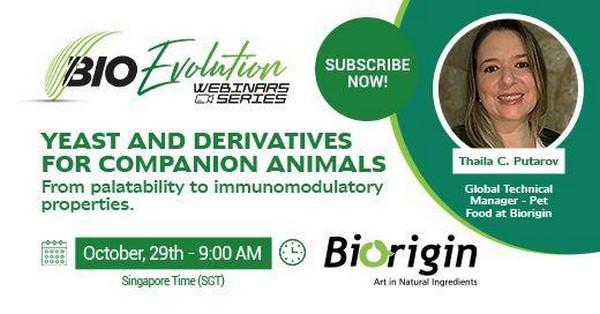
Continuing its program of BioEvolution Webinar Series, Biorigin promotes on October 29 th at 9 am (Singapore time – SGT) the webinar 'Yeast and derivatives for companion animals: From palatability to immunomodulatory properties' presented by Thaila Cristina Putarov, Biorigin Global Technical Manager Pet food, a specialist in companion animal health and nutrition.  Yeast and its derivatives products are well known for their benefits in animal nutrition and are mainly used to help balance the intestinal microflora and help stimulate the host's natural defenses, besides the effects on palatability of pet food. 'Exploring and understanding the world of yeast and how these ingredients could be applied to pet food to reach the right objectives in a formulation are the mainly goals of this webinar', complements Mrs. Putarov. The webinar is free of charge and the registration is open on the link: https://gonatural.biorigin.net/webinar-pet-asia About Thaila Putarov Animal scientist with focus on companion animal nutrition and pet food processing. Her masters and PhD degrees were taken on companion animal health and nutrition and her postdoctorate training was based on the evaluation of pet food processing. From 2014 to 2020, Thaila was the coordinator of a center of research in companion animal nutrition. Since last July she is the technical manager for pet food at Biorigin.  About Biorigin Biorigin is a Brazilian company, founded in 2003, which mobilizes knowledge and technology to, using biotechnological processes, develop innovative solutions in 100% natural ingredients for the animals' health and well-being. Its portfolio is composed of 100% safe ingredients, assured by the total traceability of the vertically integrated production process, in addition to the quality assured by certifications FSSC 22000, ISO 22000, ISO 14001, GMP+ (Feed Safety Assurance), Kosher (food produced according to Jewish norms) and Halal (food produced according to Islamic requirements). It is the first company in its segment certified by The Bonsucro Chain of Custody for yeast extracts and derivatives produced from fermentable sugar and sugarcane yeast cream, as well as Ecovadis gold rating and Smeta audit showing the Biorigin's commitment to social, environmental, and economic practices through sustainable supplying.  www.biorigin.net   by All Extruded

Essential Nutrients for Companion Animals
Minerals

2+ MIN

Essential Nutrients for Companion Animals

They're our walking partners, service pets, and loyal friends. They're our children's secret keepers, snugglebugs, and playmates. They're our front door greeters and unofficial therapists. They support and bring joy to our uniformed men and women abroad and at home. They are, in the fullest sense of the word, our companions, and that's why we work so hard to make sure they get the trace minerals they require—and deserve—for exceptional health and wellbeing. Trace minerals, including zinc, manganese, and iron, are often referred to as micronutrients. Although they are required only in small daily amounts, they play an essential role in numerous metabolic functions. When fed as part of a well-balanced diet, trace minerals provide dogs, cats, birds, rabbits, ferrets, and guinea pigs with multiple benefits, including skin and coat quality, growth and development, reproductive performance, paw pad integrity, and energy metabolism. With Zinpro Performance Minerals® in a companion animal's diet, you'll see a visible difference in the health and appearance of your walking partner, your service pet, your child's best friend—companions that are essential to our own wellbeing and happiness. The Difference is Noticeable As trace minerals with the highest biological efficacy on the market, Zinpro Performance Minerals® allow companion animals to absorb more of these trace minerals to receive their full benefit. With the addition of Zinpro Performance Minerals to food, treat, and supplement formulations, you'll see a noticeable difference in the health and appearance of companion animals, such as: Health & Wellbeing Zinc, manganese, copper, and selenium have been shown to enhance and support immune function, including antioxidant activity to remove free radicals and protect cell membranes Skin & Coat Quality Zinc and manganese facilitate wound healing and skin integrity through improved epithelial production and repair, and they, in addition to iron, are important factors in optimal coat, hair length, and shine Paw Pad Integrity & Healing Zinc and manganese have been shown to aid in keratin synthesis for toenail hardness, antioxidant activity to protect cell membranes, and cell division for paw pad growth and repair Growth & Development Zinc is shown to improve skeletal soundness, manganese plays a vital role in bone matrix development and joint maintenance and repair, and iron contributes to overall growth and development Reproductive Performance Manganese has been shown to aid reproductive hormone production, while research shows zinc to improve reproductive performance in both males and females Energy Metabolism Zinc, manganese, and iron contribute to energy metabolism, including carbohydrate,
lipid, protein, and nucleic acid metabolism Source: ZINPRO

Dogs prefer to eat Fat, and Cats surprisingly tend toward Carbs
Minerals

4+ MIN

Dogs prefer to eat Fat, and Cats surprisingly tend toward Carbs

Dogs gravitate toward high-fat food, but cats pounce on carbohydrates with even greater enthusiasm, according to research into the dietary habits of America's two most popular pets. The study sheds new light on optimal nutrition for the animals and refutes a common notion that cats want and need a protein-heavy regimen. Findings were published in the Journal of Experimental Biology. "The numbers were much different than what traditional thinking would have expected," said the study's corresponding author, Jean Hall, a professor in the Carlson College of Veterinary Medicine at Oregon State University. "Some experts have thought cats need diets that are 40 or 50 percent protein. Our findings are quite different than the numbers used in marketing and are going to really challenge the pet food industry." Dietary proteins contribute to a number of important physiological functions such as blood clotting, production of hormones and enzymes, vision and cell repair. Protein also has the most power to make the eater feel satiated; carbohydrates are No. 2 in that regard, followed by fat. Hall's research involved monitoring 17 healthy adult dogs and 27 cats over 28 days and used four types of food that were designed to taste equally good; with flavor out of the equation, the animals could make macronutrient choices based only on what their bodies were telling them they needed. "Previous studies have shown that if you don't balance palatability between foods, cats do in fact prefer to eat very high levels of protein and dogs want to eat a lot of fat," Hall said. "When you balance palatability, both dogs and cats prefer significantly different macronutrient content than what they would choose based on taste." The animals studied by Hall and her collaborators could choose among high-fat, high-carbohydrate, high-protein and balanced foods. Each day, dogs had an hour to eat all they wanted up to a predetermined caloric intake -- that is, they could get all the calories they needed for metabolic requirements and to maintain weight, but no more. The cats in the study were likewise not allowed to overeat, though even if given unlimited access to food that tastes how they like it, cats tend to eat in a weight-maintenance way by adjusting their intake based on the food's energy density. In the study, cats had 24-hour food access up to the point of hitting their caloric threshold. Food container placement for both dogs and cats was changed daily to guard against "bowl position bias" affecting the results, which showed the cats on average chose to get 43 percent of their calories from carbs and 30 percent from protein. Dogs on the other hand went for 41 percent fat and 36 percent carbs. Not a single dog or cat chose to get the highest percentage of its calories from protein. Within the aggregate cat findings were trends correlating with age and lean body mass -- how much muscle an animal has. Younger cats with less lean body mass tended more strongly toward protein consumption than younger cats with more lean body mass; younger cats in general wanted protein more than older cats. On the dog side of the study, high-protein foods were the least popular among younger animals with less fat body mass; dogs with greater fat body mass had the strongest preference for getting calories from protein. "Because the choice of macronutrients was influenced in both dogs and cats by age and either lean body mass or fat body mass, that suggests a physiological basis for what they chose to eat," Hall said. The research also involved determining the diets' effect on selected metabolites of each macronutrient class -- what they break down into in the body. Hall found the older cats' blood had much lower levels of DHA, a long-chain omega-3 fatty acid that's important for the brain, heart and eyes, than the younger cats. "None of the foods had ingredient sources of DHA or EPA, another long-chain omega-3, but cats are able to synthesize DHA by elongating and desaturating fatty acids," Hall said. "The older cats, though, are a lot less efficient at that." More potential bad news for the older cats: Their concentrations of sulfated microbial catabolic products -- protein-breakdown leftovers that in humans are connected to cardiovascular and kidney disease -- were significantly higher. "Just like with older people, older cats may have a different gut microbiome than younger cats, which would mean different microbial metabolic activities," Hall said. Basically, if a younger cat gets more protein than it can use, it can safely deal with and dispose of the excess a lot better than an older cat can. The Pet Nutrition Center of Hill's Pet Nutrition, Inc., supported this research. by Oregon State  University Source : All Extruded